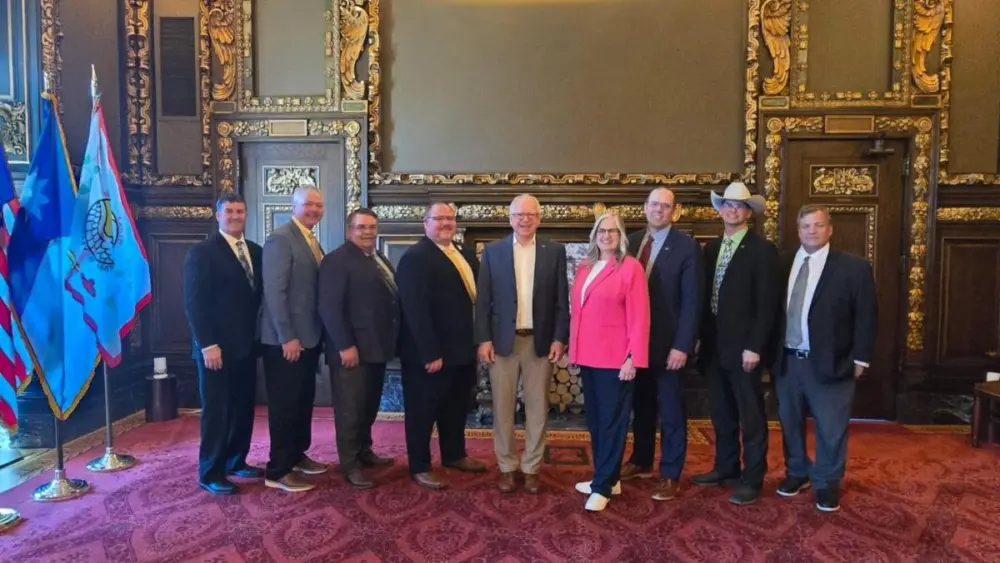
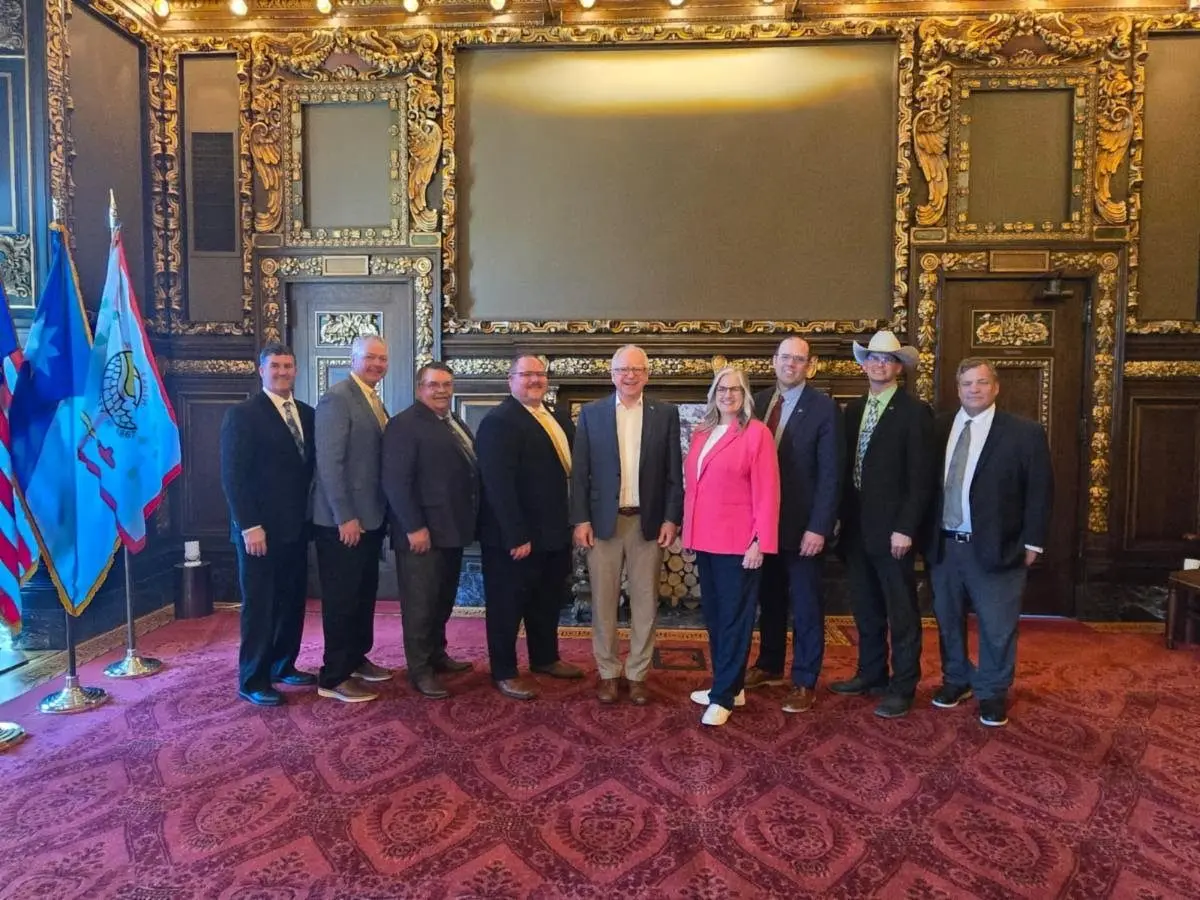
Pictured: Members of the Minnesota Farm Bureau Board of Directors met with Governor Tim Walz and other key leaders in May as final bill negotiations were underway towards the end of session. L to R: Nathan Collins, Peter Bakken, Bruce Brenden, Jeff Pagel, Gov. Tim Walz, MFBF Vice President Carolyn Olson, President Dan Glessing, Miles Kuschel and Department of Agriclture Commissioner Thom Petersen.
EAGAN, Minn. – The Minnesota Farm Bureau Federation (MFBF) engaged with legislators, state agencies, and other leaders throughout the 2025 state legislative session to advance policies shaped by its grassroots members to ensure the vitality of agriculture and rural communities across the state.
MFBF had a daily presence at the Capitol, serving as both a trusted voice for agriculture and a valuable resource for legislators looking to understand the challenges faced by farmers and ranchers. MFBF members also met with their elected officials at the Capitol and in their districts throughout the session, and MFBF board members met with key legislators in the final weeks as bill details were negotiated.
“We appreciate the legislators in both the House and Senate who worked together on the agriculture omnibus bill to deliver solutions that support our farmers and ranchers today, while also strengthening agriculture for generations to come,” said MFBF President Dan Glessing. “Although agriculture is a top contributor to the state’s economy, it receives only a quarter of a percent of the overall state budget. We know receiving full funding for the Minnesota Department of Agriculture and support for other programming will make a significant impact.”
Guided by its grassroots members, the MFBF Board of Directors set its 2025 priority issues focusing on: Generational farming, research & innovation, environmental stewardship, economic & rural prosperity, and animal emergency preparedness. The public policy team was able to work with legislators to advance policy in each of these areas, with MFBF contributing over 40 verbal and written testimonies on bills in both the House and Senate.
Continuing to drive agriculture forward and securing its vitality for the next generation, the legislature put forth initiatives through programming, including funding for the Agriculture Research, Education, Extension, and Technology Transfer (AGREET), the Farm Business Management Program (FBM), Agricultural Growth, Research, and Innovation Program (AGRI), Farm-to-School and Early Care Programs, Livestock Protection Grant, the Meat, Poultry, Egg and Milk Processing Grant, Agricultural Utilization Research Institute (AURI), Minnesota Agricultural Education and Leadership Council (MAELC).
Environmental stewardship highlights included continued funding for the Soil Health Financial Assistance Program, a state study on expansion of the Olmsted County Soil Health Program, and establishment of a biofertilizer innovation and efficiency program.
The legislature also took steps to advance agriculture as an economic driver in the state, while supporting initiatives for surrounding rural communities and farmer well-being. This included: Continued support for mental health resources and farm safety grants, dollars for wastewater treatment upgrades at the First District Association in Litchfield, support to increase high-speed internet access across the state, funding for county fair resources, and new investments in the Minnesota Agriculture and Rural Leaders program (MARL).
Finally, the state looked to help producers address emergencies, with increased funding to the Board of Animal Health, Agricultural Emergency Account, and Wolf and Elk Depredation Accounts.
“We appreciate the forward-thinking investments that help farmers prepare for unexpected challenges,” said MFBF Vice President Carolyn Olson. “Support for emergency preparedness, along with education and leadership development, ensures agriculture remains strong and will continue to grow in Minnesota.”
About the Minnesota Farm Bureau Federation
To ensure Minnesota’s agricultural vitality, the Minnesota Farm Bureau amplifies its members’ voices through engagement, grassroots advocacy and agricultural awareness. Learn more about our efforts as an advocate for our 31,000 members and 78 county and regional Farm Bureaus at www.fbmn.org.