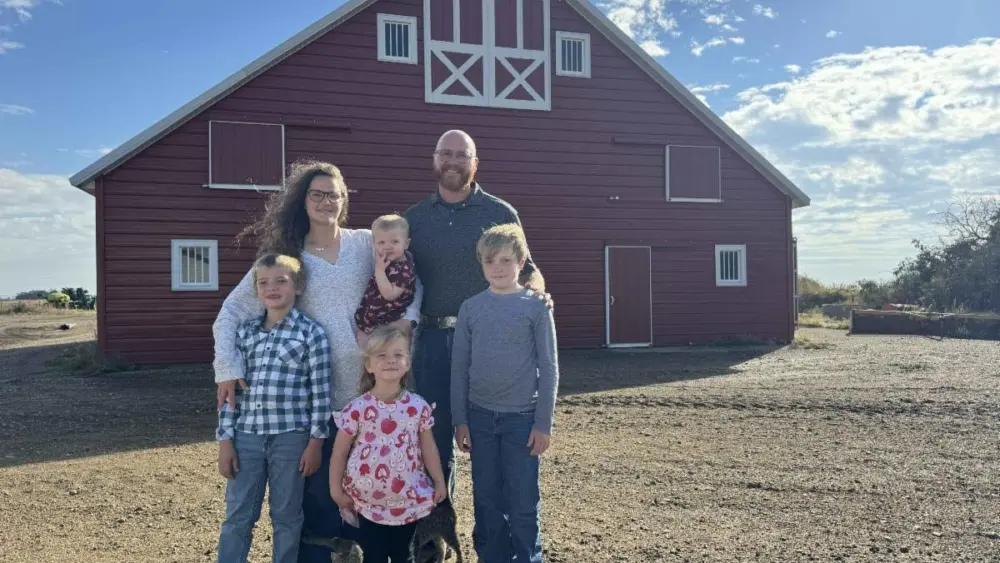
The Westhoff family farms in McCook County: Shaina and Paul with their children, William, 6, Tessa, 4, Ruby, 1, Paul, 8.
Weekday mornings can be a bit chaotic on the Westhoff Farm.
Shaina needs to be out the door and on the road by 6:45 a.m. to teach at South Dakota State University. So, before he heads to the farm, Paul is in charge of getting 8-year-old Paul and 6-year-old William on the school bus by 7:45 a.m. and 4-year-old Tessa and 1-year-old Ruby to daycare.
“It can be stressful sometimes, but being a dad is pretty great,” said the fifth-generation McCook farmer.
Raising the children on the family farm is important to Paul and Shaina.
“Out on the farm the kids can be very loud, and no one gets mad, and they learn responsibility,” Shaina said. “I love getting home from work and telling my 6 and 8-year-olds, ‘you need to do chores – feed the kitties and get the eggs.’”
Unlike Paul, Shaina did not grow up on a farm. She grew up near Minneapolis. In school she enjoyed both English and science but found science classes more interesting.
Curious about how food was raised, Shaina enjoyed spending time on a friend’s farm. It was there that she learned about career opportunities in soil science and agronomy, which led her to attend South Dakota State University and to pursue degrees in agronomy and environmental management. Shaina and Paul met at SDSU.
Shaina went on to receive a master’s and eventually a doctorate in plant science from SDSU. Today she teaches in the Agronomy, Horticulture and Plant Science Department there.
“I enjoy working in this very critical and unsung American industry,” Shaina said. “It often shocks people when they learn that I did not grow up on a farm, but the nurse who put the IV in my arm when I had my child did not grow up nursing and my banker did not grow up banking – so you don’t have to grow up farming to work in agronomy and soil science.”
Shaina said her favorite part about teaching is watching students become more interested in a subject they thought would be boring as they learn more about “why” and “how” things work the way they do.
In addition to their farm being a great place to raise their children, Shaina enjoys getting to see the practices she discusses in the classroom implemented in Paul’s fields.
“I enjoy actually seeing how management practices alter the soil properties. Living on the farm helps me when I am teaching because I can discuss the application of practices on our farm,” Shaina explained.
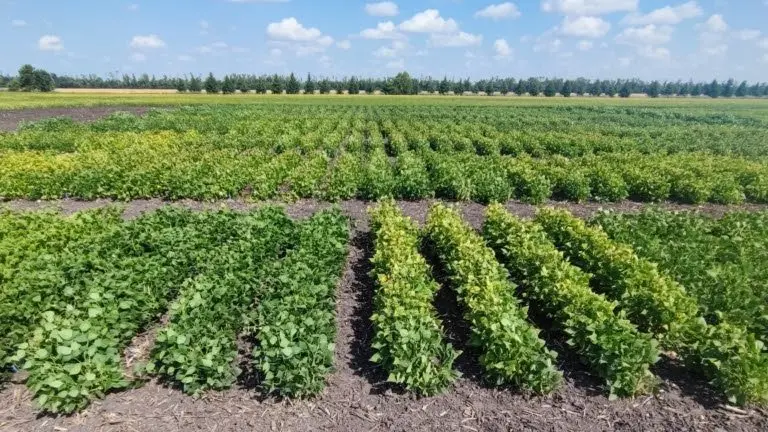
Today nearly all of Paul’s fields are managed with no-till practices. To overcome the yield hit crops typically take in the early years of no-till, Paul bands nutrients.
“You get more bang for your buck banding nutrients. We still dry broadcast some fertilizer, but a portion of the fertilizer goes in the furrow with the seed,” Paul explained. “I tell other farmers, it is a pain in the butt, because you have to stop every 80 acres to refill, but because banding nutrients provides the seed with everything it needs for the critical early growth stages, the difference is noticeable.”
Paul rebuilt a planter, adding the precision section control equipment and technology needed to apply fertilizer in the seed furrow right beside the seed as it is planted. Paul also rebuilt an air seeder for soybean planting.
“I can rebuild old equipment for a quarter of the price of buying new,” Paul said. “I have always been mechanical. My dad was this way. He always fixed his own equipment.”
When Paul reflects on his farming philosophy, he explained that his dad, Dan, had a strong influence.
Dan was a meticulous recordkeeper. And so is Paul.
“It is all about running the farm as a business, I always know what my costs are, so that I can be as efficient as possible,” Paul said.
Dan invested in on-farm storage because he wanted control over grain marketing. In 2018, Paul added 84,000 bushels of storage. “At this point we have enough on-farm storage for all our crop. Some years you can really make money putting it in the bin and holding on to it … and some years you cannot,” Paul said.
On-farm storage also increases efficiencies at harvest – no lines to wait in to unload. Paul explained that when he does have time to haul grain, he can let price guide where he delivers.
“Rather than taking it all to town where the basis is not very good, we can contract it to the ethanol plant that is 45 minutes away,” he said.
Before Dan passed away from stomach cancer January 2025, he took the time to put together an estate plan to keep the farm in the family.
“Dad was adamant about an estate plan. He said, ‘this farm cannot get sold every generation.’ He had seen too many times where Grandpa buys some ground and Dad buys some ground and the kids have to rebuy all the ground – it can kill a family farm.”
Paul and Shaina plan to create a similar transition plan for their children.
Fighting to keep the farm going is part of the Westhoff farm legacy.
“My great-great-grandpa lost the original place during the Depression. So, my great-grandparents bought the homeplace from an insurance agency in 1938 as the Depression was winding down,” Paul said.
Dan’s dad, Gene, passed away in the 1970s, so Dan took over when he was only 23. After Paul’s mom, Donna, was tragically killed in a farm accident, with four children to raise, Dan made the difficult decision to keep farming instead of getting a job in town.
“It was a lot of stress for Dad, and he contemplated whether he wanted to farm or not at that point,” Paul said.
Paul’s oldest sister, Danielle, and his Grandma Bernette helped take care of him and his siblings. “We spent a lot of time with Grandma, especially during harvest. Dad would have to be in the combine, so we would go to Grandma’s house in town after school and he would pick us up in the late evening and put us to bed.”
Paul said when he graduated from high school, he was not sure if he wanted a farming career, but once he got to SDSU, he missed the farm.
“Out here on the farm, everything is a puzzle. Sometimes that is fun, and sometimes it is frustrating and challenging – but that is why I enjoy farming,” Paul said.
After college, Paul put his agriculture systems technology degree to work at an equipment manufacturer in Madison. He worked full time and farmed with his dad. Then in 2018, when his dad was ready to retire, he made the decision to farm full time.
“I’m happy to continue our family farm legacy because it is really about honoring my great-grandparents and my grandparents and my parents – everyone who came before and helped build the farm,” Paul said. “And hopefully continue it into the future so that someday one of my kids or a couple of my kids will take over.”