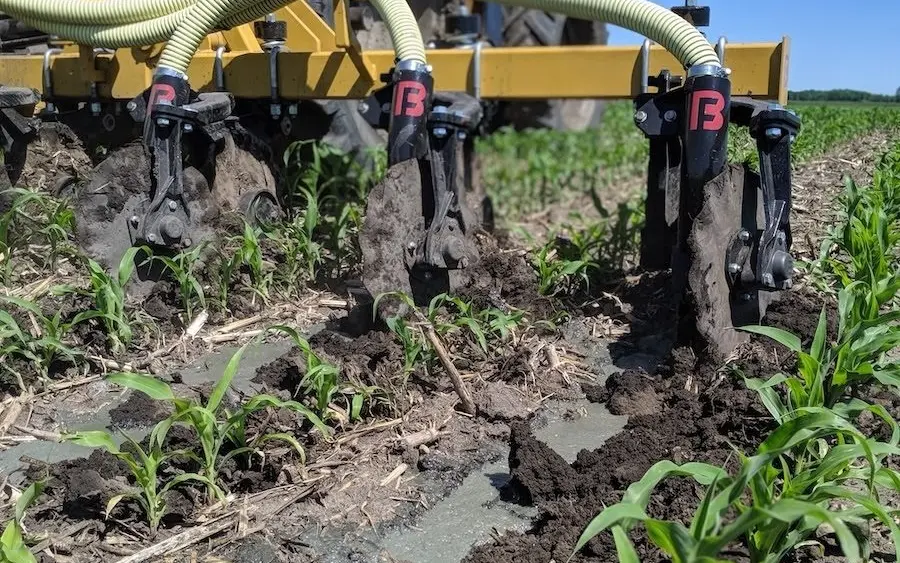
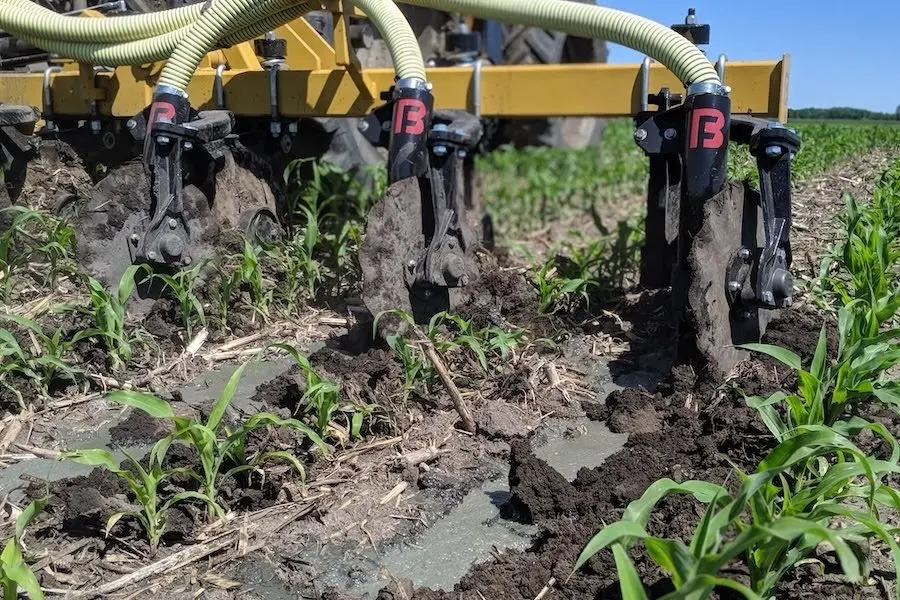
Side dressing manure in corn. Credit: Melissa Wilson, University of Minnesota.
MINNEAPOLIS/ST. PAUL (12/15/2025) — Manure is an important nutrient fertilizer source for crops but also has the potential for environmental loss. Better information will improve nutrient management planning, agricultural and conservation program prioritization, and agricultural and environmental modeling efforts.
Many previously-published manure nutrient characteristics rely on decades-old data from narrow geographic locations, which can limit their value. A team of University of Minnesota researchers saw a need for updated manure nutrient estimations and envisioned a dynamic database of manure nutrient data.
With support from the U.S. Department of Agriculture and collaborations with the Minnesota Supercomputing Institute and the Minnesota Department of Agriculture, the team worked with laboratories, researchers and other data collaborators to bring together and standardize manure sample data from across the country into a first-of-its kind manure nutrient database called ManureDB.
ManureDB, a publicly available database, houses U.S. manure and organic amendment data from multiple laboratory sources. The ManureDB website allows for simple summaries, data visualizations and data downloads.
ManureDB was detailed in an article published in the Journal of the ASABE from the American Society of Agricultural and Biological Engineers.
“ManureDB provides real, up-to-date information that reflects current manure handling and storage practices,” said Melissa Wilson, an associate professor in the College of Food, Agricultural and Natural Resource Sciences and a member of the ManureDB project team. “Since we will continue to add data over time, we will be able to track trends that we have not had access to in the past.”
While the project team still recommends individual farms sample their manure to create nutrient management plans tailored to their operations, this resource gives an opportunity to benchmark their results to the ManureDB collective. This database also gives a better estimate for new livestock operations and agricultural and environmental modelers with samples across more geographies than previously available. This team continues to add data from new and existing partners and is currently working with an American Society of Agricultural and Biological Engineers committee to update the Manure Characteristics standard.
Funding for this project was provided by the Natural Resources Conservation Service and National Institute of Food and Agriculture at USDA.