Brian - stock.adobe.com
WASHINGTON – Today, The Brotherhood of Locomotive Engineers & Trainmen and The Brotherhood of Maintenance of Way Employees representing 53 percent of the unionized workforce at the Union Pacific Railroad and Norfolk Southern Corporation, announced their opposition to the $85 billion plan to merge the carriers. The decision to actively oppose the proposed tie-up was not made hastily. The two unions which comprise the Teamsters Rail Conference, conducted five months of investigation, held meetings across the nation to listen to union members employed at both railroads, and negotiated directly with Union Pacific’s CEO Jim Vena.
The proposed merger will make railroads less competitive with other forms of transportation
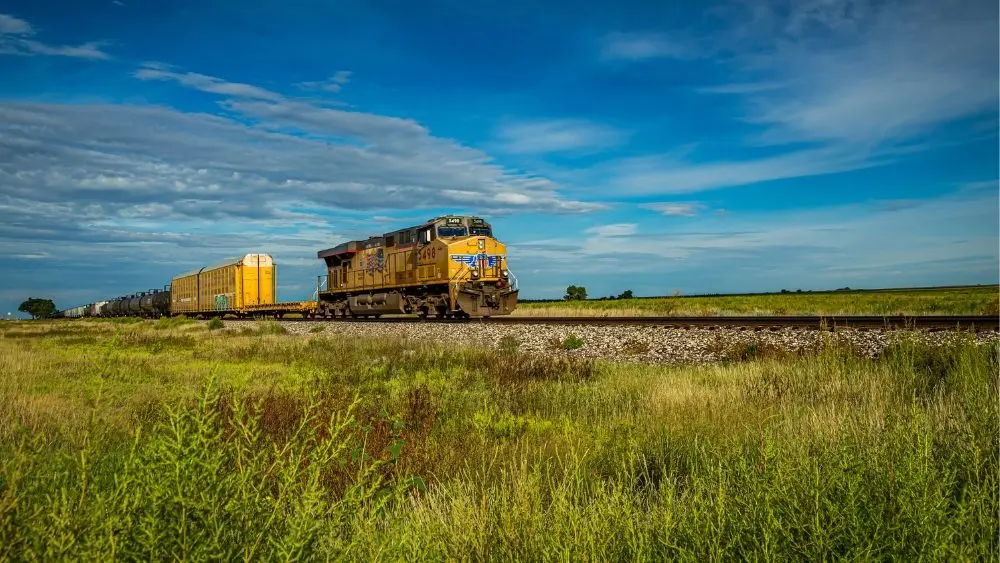
In 1980 there were roughly 40 Class I railroads in the United States. In 2025 that has been reduced to six Class I railroads operating in most parts of the country as a duopoly. The “Supersized” transcontinental railroad, to be called Union Pacific, that would be created by the UP-NS merger, spanning 43 states and 50,000 miles of track, would be a de facto monopoly.
“This debt-ridden tie-up won’t make rail more competitive with trucks as merger proponents claim,” said BLET National President Mark Wallace, “We believe this transcontinental railroad will make shipping by rail less attractive as the merged carrier passes off rail lines that serve small towns, factories and farms to short line railroads while running miles-long slow-moving trains on the main line. For rail customers it will be a choice between ‘Hell or the highway.”
It’s not just the unions that see it this way, 40 chemical company CEOs signed a letter saying the merger would limit freight transportation options. More than 60 trade associations and chambers of commerce have voiced opposition to the merger.
The proposed merger will likely expand the use of unsafe practices
UP and NS are expected to formally file an application to allow the merger to go forward on December 19. The Teamster-affiliated unions say that the safety record of Union Pacific, the dominant partner in this merger, more accurately termed “an acquisition,” should be carefully examined by the Surface Transportation Board as it considers whether this acquisition should be approved.
Railroaders have learned from experience that merging two railroads together with differing cultures carries with it inherent safety risks. Last month, The Atlanta Journal-Constitution in a Sunday front-page article titled Norfolk Southern got safer after Ohio crash. Unions warn of merger risk showed that NS learned a costly lesson from the 2023 derailment in East Palestine, Ohio. UP continues to cut corners and oppose needed reforms. For example, NS has been experimenting with close call confidential reporting or C3RS, a program modeled after successful efforts to boost safety in commercial aviation. In contrast, Union Pacific has only offered lip service to C3RS. NS has undertaken what it calls “a safety transformation” while UP undermined regulators’ efforts to assess safety.
UP also has routinely been running extremely long trains, some three miles in length, that have added to both safety and security risks. The western railroad also has become highly reliant on the controversial PSR model of railroading where railroads operate longer and fewer trains with fewer employees and minimal time in yards.
Protections for workers employed by the merged railroad are mostly hollow promises
Union Pacific wants the public to believe the merged railroad will value its workers and will protect their jobs. This is an empty promise. Union Pacific’s proposals presented to its unions give the company complete control over who is protected, who is left out, and when any commitments can be changed or taken away.
“We don’t believe anything Vena says about how workers would be treated in the Supersized Union Pacific,” said BMWE’s Cardwell. “The agreements reached with some other unions related to job protections post-merger have loopholes big enough to traverse freight trains through. We refuse to accept the same terms in return for our unions’ support for the merger.”
Vena has negotiated with a few other rail unions contract language for job security covering the length of their members’ careers, but the terms agreed-to say nothing about where or how far away a worker can be transferred, demoted or when and how they can be forced into another craft or even another railroad. The agreements provide no seniority protection and no relocation benefits.
In a critical omission, the job protections reached with other unions fail to address what happens when the merged railroad unloads a rail line through sale or lease – a common practice after a major acquisition. Under the terms agreed to by other unions, if the merged carrier sells a line, the jobs leave with it. If the merged railroad leases a line to another carrier or a short line, the jobs shift to that operator and the job protections will cease to exist.
The bottom line – the STB should reject this proposed merger
“We’ve been around the track before with railroad mergers,” said Wallace. “Mergers can be messy and the very act of merging two railroad cultures creates safety risks. UP can do better. BLET and BMWE were open-minded to the merger when first announced. We reached out to Jim Vena on day one. We have met with Vena and others on his team over the past five months. The UP CEO has failed to convince us that he has the best interests of customers, workers and the communities served by rail on his agenda. As a result, it’s now our job, with the full backing of the Teamsters union, to convince the STB that this merger should be rejected.”
The Brotherhood of Locomotive Engineers & Trainmen (BLET) represents 51,000 professional locomotive engineers and trainmen throughout the United States. It is the nation’s oldest labor union. The BLET is a member of the Rail Conference, International Brotherhood of Teamsters. More information can be found on the BLET website: https://ble-t.org/
The Brotherhood of Maintenance of Way Employes (BMWE) is a national union representing the workers who build and maintain the tracks, bridges, buildings and other structures owned and operated by railroads across the United States. The BMWE is a member of the Rail Conference, International Brotherhood of Teamsters. More information can be found on the BMWE website: https://www.bmwe.org/default.aspx