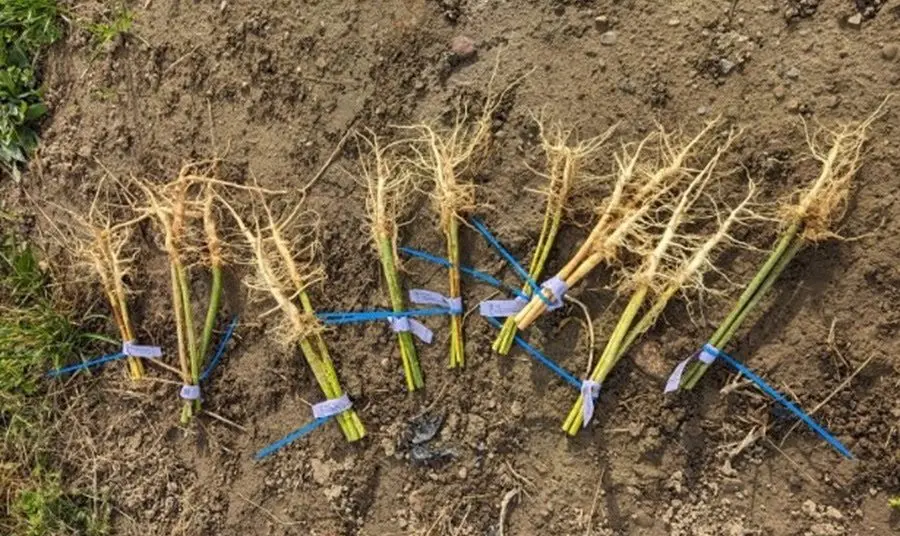
Hemp root. Image Provided by USDA PGRU Hemp Germplasm Lab - Tyler Gordon Dan Meyers and Zach Stansell
In a groundbreaking study, scientists at the U.S. Department of Agriculture, Agricultural Research Service (ARS) redefined the value of roots in industrial hemp, providing new opportunities for industrial hemp growers and opening new avenues for pediatric cancer research.
While the above ground part of Cannabis sativa L. plants, or industrial hemp, is widely recognized for its broad range of uses, including fiber production and grain (as a source of protein and oil), its roots have often been unutilized. This is because, until now, they were not considered to hold significant value.
Dr. Korey Brownstein, a research chemist with the National Center for Agricultural Utilization Research in Peoria, IL, noticed a strange substance showing up in his analysis as he was studying the chemical composition of hemp roots. Intrigued by these findings, Brownstein led a team of researchers to further investigate and analyze this chemical substance to determine its precise structure.
The analysis showed the substance was multiple compounds (four in total) that researchers predicted through structural modeling to be neolignans – natural products with similar structures formed during the plant’s biological processes. Although molecules with similar properties have also been found in other plants, such as paper mulberries and a tree native to Sumatra and the Malay Peninsula, this is the first time such molecules have been isolated from hemp roots.
The research team spent three years isolating and purifying these compounds—a process they described as ‘complex and increasingly difficult.’ Due to potential activities of the molecules, the researchers were determined to understand their nature and uncover the complete narrative behind them.
The team also collaborated with scientists at the Pediatric Oncology Laboratory at the University of Illinois College of Medicine Peoria, where a team of researchers found that these molecules showed moderate activity in killing pediatric cancer cells (cytotoxic effect) in the laboratory setting. Refining and understanding the effect of this molecule on pediatric cancers will open new alternatives for children’s cancers that are unresponsive to current therapies.
“We believe this new discovery offers industrial hemp growers a potential new revenue stream from a part of the plant that was previously overlooked,” said Brownstein. “Unlike crops such as corn or soybeans, which have multiple uses, hemp has been limited in scope. But if we treat hemp as a multi-use crop, we can expand its applications and market—paper, grain, fiber, and now, potentially, pharmaceutical compounds from the roots. The discovery of these compounds adds value to this commodity.”
The findings, published in a peer-reviewed journal, marks the first time these specific neolignans have been isolated from hemp and linked to possessing cytotoxic effects on pediatric cancer cell lines.
The team’s next steps include scaling up compound extraction for larger, more controlled functional studies. They aim to explore a broad array of cancer cell lines to assess the therapeutic potential of these neolignans in greater depth.
“This is about opening new doors,” Brownstein emphasized. “We’re expanding the possibilities for using the whole industrial hemp plant. By adding value to the roots, we’re giving farmers more stability and more reasons to invest in this emerging crop.”
——————-
The Agricultural Research Service is the U.S. Department of Agriculture’s chief scientific in-house research agency. Daily, ARS focuses on solutions to agricultural problems affecting America. Each dollar invested in agricultural research results in $20 of economic impact.