

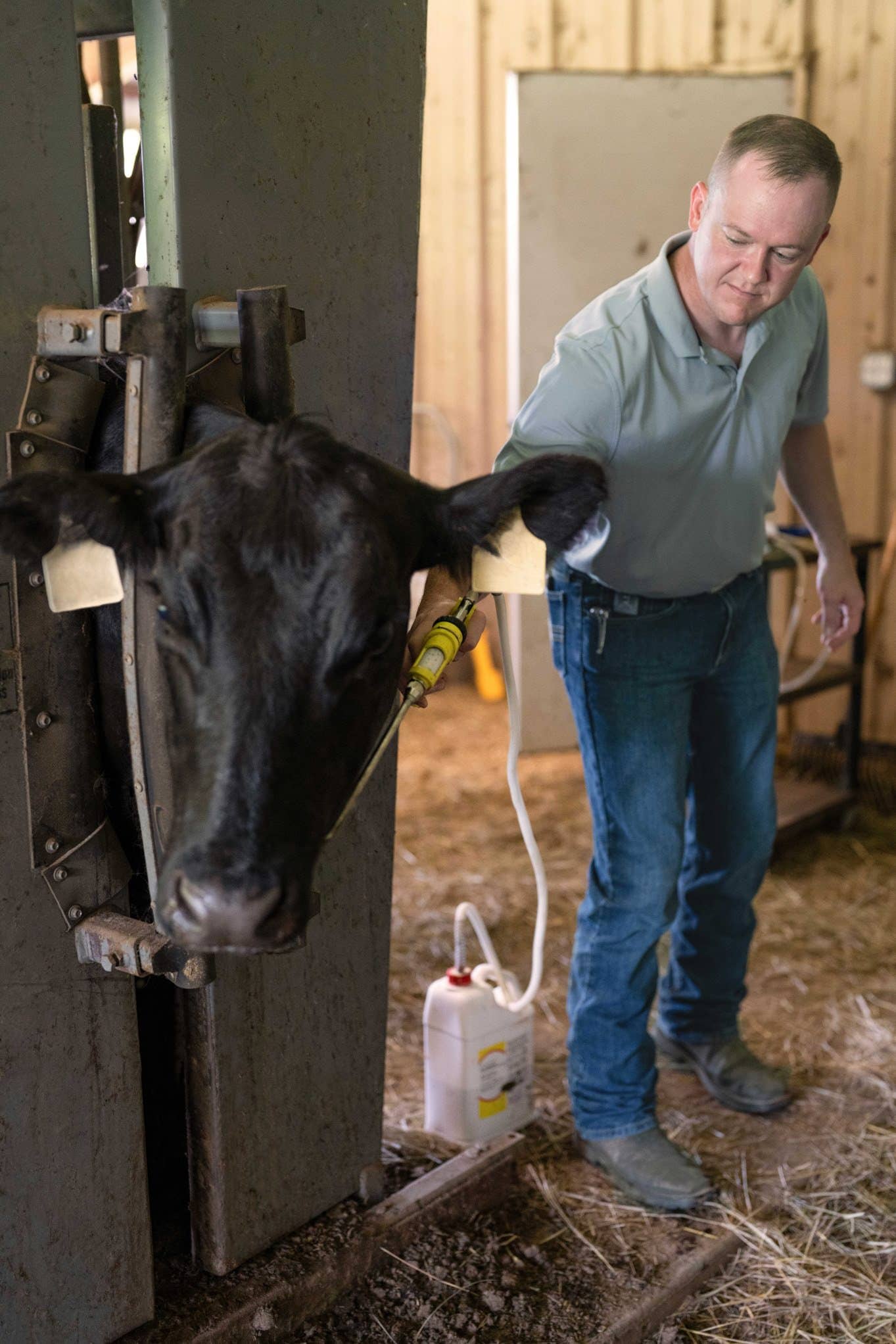
Near Okemah, Oklahoma, rancher Buck Rich has used combination treatment for several years to protect his nearly 2,000 cow-calf pairs, as part of his deworming protocol at Leaning Oak Ranch.
DULUTH, Ga. (Jan. 15, 2026) — Parasites are a hidden drain on cattle performance, quietly stealing productivity and profit from herds across the country.
For producers, the cost isn’t just in lost weight gain, but also in overall herd health and efficiency. That’s why veterinarians and ranchers alike are turning to improved parasite control strategies, like combination treatment.
“Combination treatment is the use of two or more dewormers from different classes, each with a different mode of action, to get more effective control,” said Matt Washburn, DVM, Boehringer Ingelheim.
The advantage? Each dewormer targets parasites in a different way. When used in combination, they can help reduce the number of parasites left behind. In fact, fecal egg counts in cattle herds have been shown to drop by nearly 99% when using dewormers from different classes.1
Understand dewormer classes for smarter control
To get the most out of combination treatment, it helps to understand how each class of dewormer works.
Dewormers can be divided into three different classes, based on their chemical structure and mechanism of action: macrocyclic lactones (endectocides), benzimidazoles (white dewormers) and imidazothiazoles. Each class controls a distinct spectrum of parasites, and for a different amount of time (see Figure 1).
“Some classes of dewormer do a better job controlling certain parasites than others,” stated Dr. Washburn. “Endectocides provide strong coverage against both internal and external parasites, while white dewormers work well against only internal parasites.”
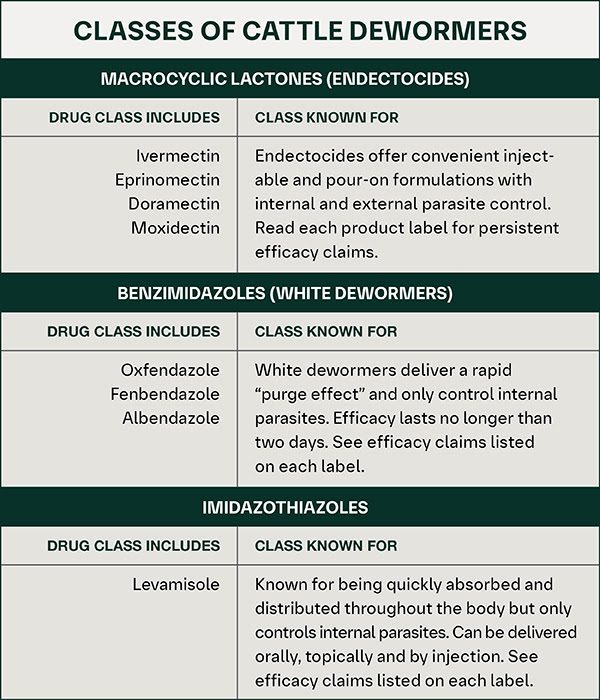
There are also differences in how long the dewormers will persist in the animal.
“Most of our macrocyclic lactones have a persistence of about 28 to 30 days, with the exception of the extended-release dewormer, with which we can get out to 150 days,” shared Dr. Washburn. “On the other side of that, you’ve got the benzimidazoles, which are also known as purge dewormers, because they’re going to clean the animal out, and in two days, they’re gone.”
Putting combination treatment into practice
Near Okemah, Oklahoma, rancher Buck Rich has been using combination treatment for several years under the guidance of his veterinarian, Dr. Tyler Thomas, to protect his nearly 2,000 cow-calf pairs, as part of his deworming protocol at Leaning Oak Ranch.
“We’ll normally use an injectable, and then we’ll do an oral drench,” said Rich. “It seems to work really well for us, and cleans those cattle up a little quicker. That’s our go-to protocol now.”
Depending on the time of the year, Rich may apply a pour-on dewormer to the calves instead of an injectable, as part of his combination treatment protocol for additional coverage.

Strategic timing can also make combination treatment even more effective, especially when cattle are carrying their highest parasite loads. “Using combination treatment, you get a better clean-out up front, and you’ll see it on the cattle, particularly coming out of winter, when our highest parasite load occurs,” said Dr. Thomas. “They’ll shed that winter coat off, they get fat, and they look good.”
Recommending combination treatment to producers for the first time can sometimes be a tough conversation, because of the additional cost of another dewormer.
“Going from a single class to combination therapy, producers are almost always on a macrocyclic lactone, and they’re adding a white dewormer to it,” noted Dr. Thomas. “I would just tell them it’s well worth it, it’s very economical, and it doesn’t take much more effort. If anybody tries combination treatment, they can see the results in the cattle.”
Rich is one of the producers Dr. Thomas has worked with who has seen benefits from implementing a combination treatment protocol.
“We’ve seen a drastic change,” said Rich. “The cattle look better. Their hair coat is better. I really think combination treatment is worth it for our operation.”
Combining parasite control programs
Healthy cattle that put on weight and stay in condition are reason enough for Rich to continue implementing combination treatment and other deworming practices advised by Dr. Thomas.
“We’re getting paid for pounds of beef at the end of the day,” related Rich. “Using a quality deworming program helps put on more pounds, which is always a benefit in our business.”
For long-term success that helps drive performance and profitability, combination treatment should be part of a broader parasite control plan that includes:
- Diagnostic testing: Performing routine diagnostic tests, such as fecal egg count reduction tests (FECRT) and coprocultures, can help assess the effectiveness of a deworming program and identify the parasites that may be surviving treatment.
- Refugia: Intentionally not deworming a small percentage of the herd is recognized as an important factor in delaying the onset of parasite resistance.2
- Management: Producers can increase overall herd immunity through routine vaccinations and enhanced nutrition. Limit overgrazing, maintain appropriate forage height, and rotate pastures, if possible.
When evaluating deworming practices, be sure to include a veterinarian in the process, similar to how Buck Rich and Dr. Tyler Thomas have collaborated to develop a parasite control plan for Leaning Oak Ranch.
To further investigate combination treatment and the other deworming strategies, tune into Out Here with the Legends, where Buck and Dr. Thomas discuss all things sustainable deworming.