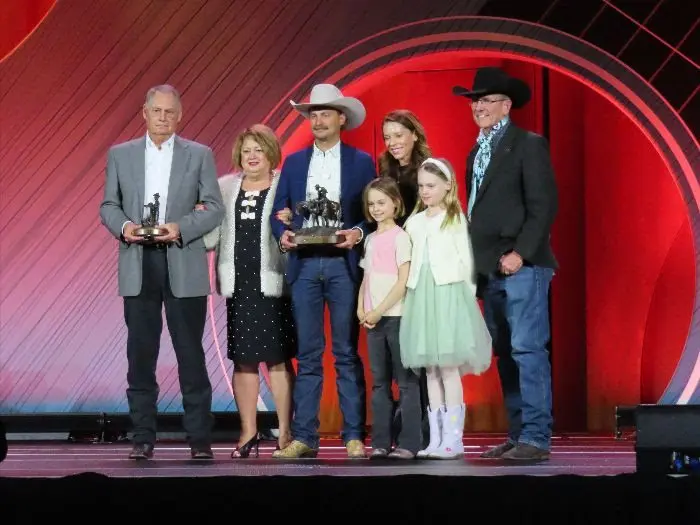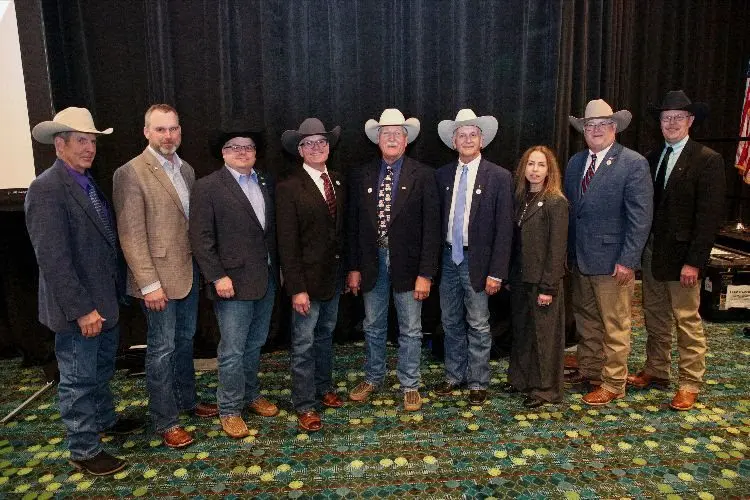
Skye Krebs, Dan Hanrahan, Travis Maddock, Brad Hastings, Kenny Rogers, Buck Wehrbein, Kim Brackett, Gene Copenhaver, Scott Anderson (left to right)
NASHVILLE, Tenn. – Since 1850, Gene Copenhaver’s family has been rooted in the land raising crops and livestock. The Virginia cattleman now takes the helm as the new president of the National Cattlemen’s Beef Association (NCBA). Copenhaver’s new leadership role began at the end of CattleCon 2026, held this week in Nashville, Tennessee.
The 2026 NCBA officer team was approved by the NCBA Board of Directors and includes Kim Brackett of Idaho, president-elect, and Skye Krebs of Oregon, vice president. Kenny Rogers of Colorado was elected chair of the NCBA Policy Division and Scott Anderson of Oklahoma was elected policy vice chair. Travis Maddock of North Dakota and Dan Hanrahan of Iowa, were elected as chair and vice chair of the NCBA Federation Division, respectively. Brad Hastings of Texas will serve in the role of NCBA treasurer.
Copenhaver currently manages his family’s stocker operation in southwest Virginia with his son, Will, and was an agriculture loan officer for 38 years. He has been married to his wife, Jodi, for more than 35 years, and they have three grown children, Brad, Will and Jaymee, and three granddaughters.
Copenhaver’s father taught him early to “be at the table,” especially when policy decisions were being made. About 25 years ago, he helped launch a county cattlemen’s group, then worked his way through leadership roles at the state level, eventually serving as president of the Virginia Cattlemen’s Association. Nationally, he became involved with NCBA, serving on the Tax & Credit and International Trade committees, multiple task forces, and the officer team. If there is a single theme to his leadership philosophy, it is grassroots engagement.
“I’ll go to my grave saying our greatest strength is grassroots,” Copenhaver said.
The new president’s priorities are straightforward: continue what works, stay grounded in grassroots input, remain open-minded, and focus on profitability. Copenhaver wants every sector and every scale of operation to be viable. That means pushing back against regulatory barriers, supporting policies that allow reinvestment, and building on recent momentum around tax provisions.
“We can’t build the future if every good year gets taxed away before we can shore up our infrastructure,” he said.
Copenhaver remains optimistic about the future for two reasons. First is the demand the beef industry has built steadily in the last four decades. Second is the next generation — young producers who are smart, relationship-driven, and family-centered, and who want to build operations that last.
Success, for Copenhaver, is not complicated. “Build a good operation. Involve your family. Treat people right,” he said. For the industry, it means continuing to grow demand and profitability across all sectors without losing sight of its roots.