How much biomass are your cover crops producing, and what does that mean for nutrient retention and soil health? Through the Great Lakes Cover Crop Project, (UMN Extension)
ST. PAUL, Minn. — How much biomass are your cover crops producing, and what does that mean for nutrient retention and soil health? Through the Great Lakes Cover Crop Project, Minnesota farmers are helping to answer that question using a simple protocol based on photos and height measurements. Results will help build practical, local data to guide better cover crop management and nutrient decisions. In this blog post, explore last year’s data from 133 Minnesota fields and how you can participate in 2026.
The project and new method for farmers
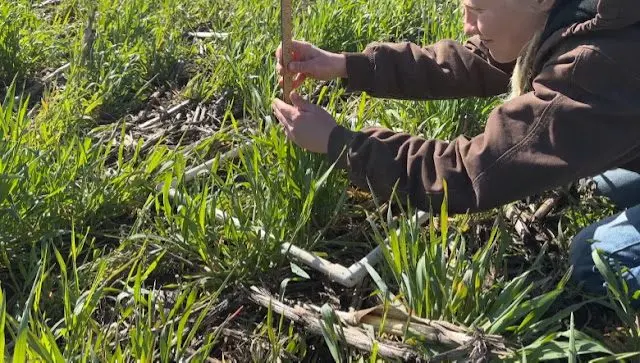
As part of the Great Lakes Cover Crop Project, farmers participate as community scientists by collecting cover crop measurements in their fields. Measuring cover crop growth, or biomass, has historically involved clipping plants within a defined area (e.g., using a quadrat) and then drying and weighing them, which can be time consuming. To simplify this process, we developed a new protocol to estimate cover crop biomass using just photos, plant heights, and weed pressure ratings. Farmers can now easily report these data from their fields to help us quantify cover crop biomass across many locations and farming conditions.
In addition to reporting cover crop data, partnering farmers submit a short management survey. The management survey helps our team identify which practices work well across different conditions, informing context-specific management recommendations. We also integrate environmental data, such as precipitation and growing degree days, to understand how climate influences cover crop outcomes.
This project aims to help farmers achieve continuous living cover through successful cover crop use. Cover crop biomass is a key indicator of overall cover crop performance. Previous research has shown that benefits such as nutrient recycling, nitrogen supply, weed suppression, and the potential to build soil health all increase with increasing biomass (Finney et al. 2016; Blesh 2018; MacLaren et al. 2019; McClelland et al. 2021).
Given the importance of biomass, it serves as a key performance indicator in this project. For example, previous research has shown that cover crops should reach at least 1,000 lbs/acre to significantly improve nutrient retention and reduce nutrient losses (Thapa et al. 2018), and 2,000 lbs/acre for tangible soil health improvements (Blanco‐Canqui, 2022). Equipping farmers with an easy way to evaluate cover crop biomass in their fields can help them better understand whether their field has enough growth to reap important benefits.
First year’s results
To see the (anonymous) data from last year’s project cohort, view this embedded map.
A brief summary of participating fields and outcomes is included below, but to make robust management recommendations, we need two years of data, and so we are currently recruiting for the next cohort to participate this spring.
In 2025, data was collected from 133 fields across Minnesota, with much of the data coming from southern and southeast Minnesota.
Of the 133 enrolled fields, 83% were seeded with a single species of cereal rye. Almost all of the cover crop mixes contained cereal rye as well.
We generally found that earlier planting dates led to greater biomass, especially when seeded after an early-harvest crop, such as canning crops (peas, sweet corn), corn silage, oats. We are interested in learning more about other options to increase cover crop biomass, such as interseeding into a cash crop or planting a cash crop green into a standing cover crop.
We found that cover crops with higher biomass also had greater nutrient retention (e.g., N, P, and K). Greater nutrient retention means fields are less susceptible to nitrate leaching, helping protect water quality.
We found that, on average, cover crop biomass contained 33 lbs of nitrogen (N), 5.3 lbs of phosphorus (P), and 35.4 lbs of potassium (K). However, these values were highly variable, depending on the cover crop species and biomass quantity. These are not nutrient “credits” but values of nutrient uptake into the cover crop biomass. (See the Cover Crop Nitrogen Calculator.) The exact amount of nutrients released by the cover crop and made available to the next crop depends on a complex suite of factors, including soil characteristics, climate, and management.
More Minnesota farmers needed for 2026
Farmers across Minnesota keep telling us the same thing: “Cover crops are great, but it’s hard to know what to expect in my area.” That makes sense – Minnesota’s growing conditions vary a lot, and we simply don’t have enough local data on how species and planting dates translate into spring growth.
The Great Lakes Cover Crop Project is a great chance to fill some of those gaps while also getting information that’s directly useful on your own farm.
What you get:
- $50 per field (you can get paid for up to three fields, though you can submit more fields for the biomass quantity and quality report)
- A short, personalized report estimating biomass and nutrients based on your field measurements
- Contribute to a regional dataset (your data stays anonymous) that will help build better, more localized recommendations
We’ve designed the protocol to be as farmer-friendly as possible – just a few height measurements and a couple of photos before termination. No clipping or weighing.
If you’re interested, you can enroll at z.umn.edu/GLCCP
The winter management survey takes about 30 minutes, and the spring measurements take about the same.
Your participation helps build the kind of practical, on-the-ground information farmers ask for – and that we as Extension staff want to be able to provide.
Resources
- GLCCP
- GLCCP observations map
- Cover crops
- Just getting started with cover crops
- Cover crops and vegetables
Thapa, R., S.B. Mirsky, and K.L. Tully. 2018. Cover crops reduce nitrate leaching in agroecosystems: A global meta-analysis. J. Environ. Qual. 47:1400–1411.
Blanco‐Canqui, H. (2022). Cover crops and carbon sequestration: Lessons from US studies. Soil Science Society of America Journal, 86(3), 501-519.
For the latest nutrient management information, subscribe to the Nutrient Management Podcast. And don’t forget to subscribe to the Minnesota Crop News daily or weekly email newsletter, subscribe to our YouTube channel, like UMN Extension Nutrient Management on Facebook, follow us on X (formerly twitter), and visit our website.
If you have questions or comments, please email us at nutmgmt@umn.edu.