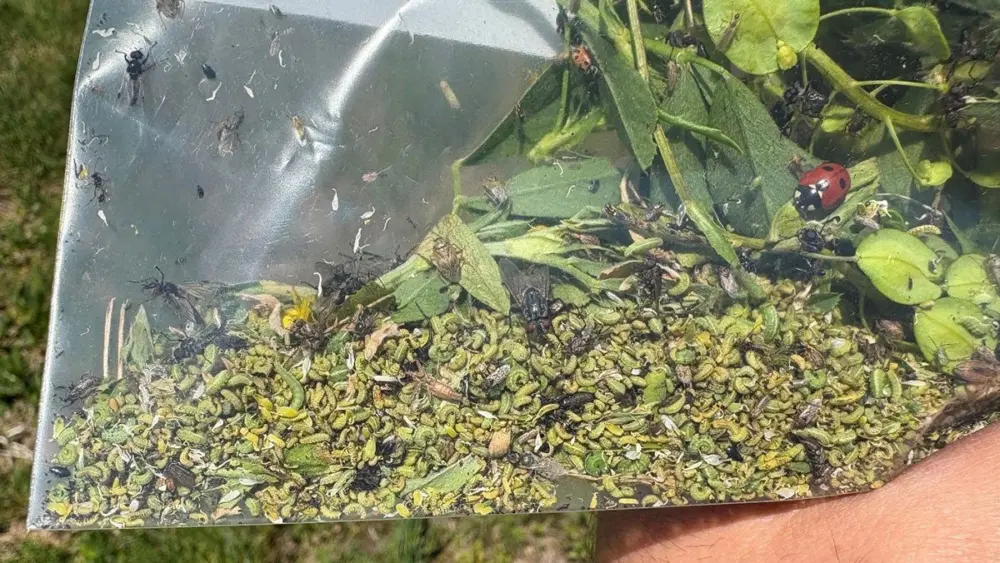
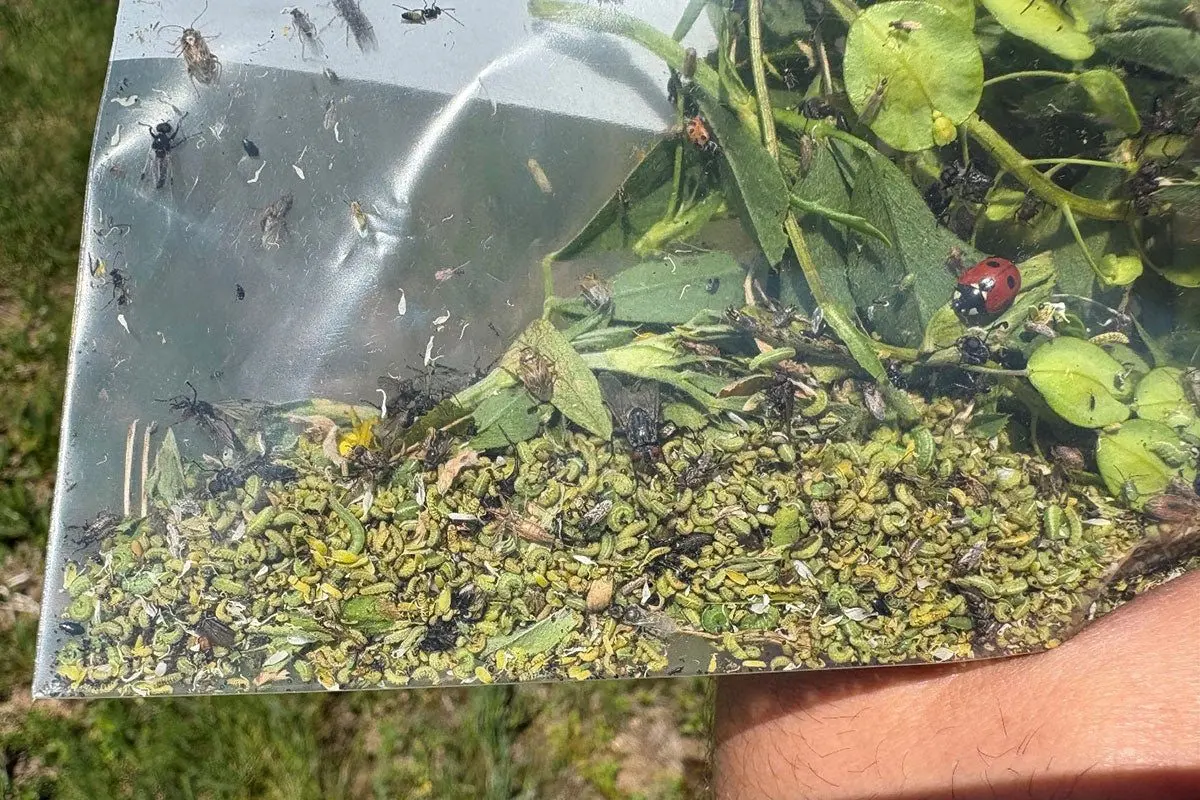
Alfalfa weevils are shown after being gathered.
MANHATTAN, Kan. – Alfalfa is Kansas’ fourth most economically valuable crops, with roughly 660,000 acres harvested annually. With dramatically changing weather temperatures recently, one Kansas State University researcher suggests that producers start scouting their fields for alfalfa weevils.
“Cold, dry weather that slows or hinders the growth of alfalfa may make it more at risk from serious weevil damage early in the season as the plants may not be able to keep up with weevil feeding,” said Anthony Zukoff, a K-State Extension entomologist.
With the warmer start to the spring season, he said it is important for producers to be aware of the accumulated alfalfa weevil growing degree days. Producers can use the alfalfa weevil growing degree day calculator available on the Kansas Mesonet website to calculate and understand what is happening in the field.
“Very tiny larvae typically are not active until around 300-degree days have accumulated,” Zukoff said. “Spraying too early, before threshold, likely will require additional spraying before the first cutting.”
When scouting for signs of alfalfa weevil larval activity, look for the presence of pinholing in the upper portions of the stem on the leaf terminal.
“Often, larvae are small enough early in the season to be able to hide very well within the terminals while feeding,” he said. “Care should be taken to sample stems in the field and actively open up terminals to look for tiny larvae and early pinholing.”
As larvae grow, pinholing of leaves develops into skeletonization of entire leaves at the top few inches of the stems. From a distance, fields heavily impacted by weevil larvae have a “frosted” or silver appearance due to the feeding at the top of the canopy.
When scouting for alfalfa weevil, Zukoff suggests using the stem count method to get an estimate of activity and damage in a field:
- Cut 30-50 stems at random.
- Shake individually in a deep-sided bucket.
- Collect an average number of larvae-to-stem.
- Measure and calculate an average of each stem height.
Zukoff said that care must be taken not to allow any larvae to drop from the stems before being shaken into the bucket. The averages from the larvae-to-stem and stem height will allow producers to decide if the field is at threshold.
“When stems are 3 to 7 inches tall and feeding is evident in the top couple inches of growth, treatment may be warranted if there are 1 to 2 larvae per stem,” Zukoff said. “Taller stands, approximately 8 to 14 inches, that show 30% or more of terminals with feeding damage and have four larvae per stem may warrant treatment.”
If the field is within two weeks or less of the normal cutting date and the threshold is met, early cutting is an option if the hay is expected to dry and be moved off the field quickly.
“The value of the cutting may have an impact on treatment thresholds as the more valuable the cutting (measured by dollars/Ton), the lower number of larvae it takes to reach threshold,” Zukoff said. “With lower value cuttings, more larvae can be tolerated before threshold is met.”
When creating treatment plans, producers should consider their coverage from previous years.
“If a producer had issues with a product achieving sufficient control last season, they should rotate to a different product, particularly one with a different mode of action than used last season,” he said.
After treatment has been applied, always follow up to determine that adequate control was achieved.
Zukoff said: “If problems are suspected and all other explanations can be ruled out (poor coverage, spray timing, or something else) reach out to your local extension professional.”
More information on alfalfa weevils can be found from K-State’s Agronomy e-Update newsletter.