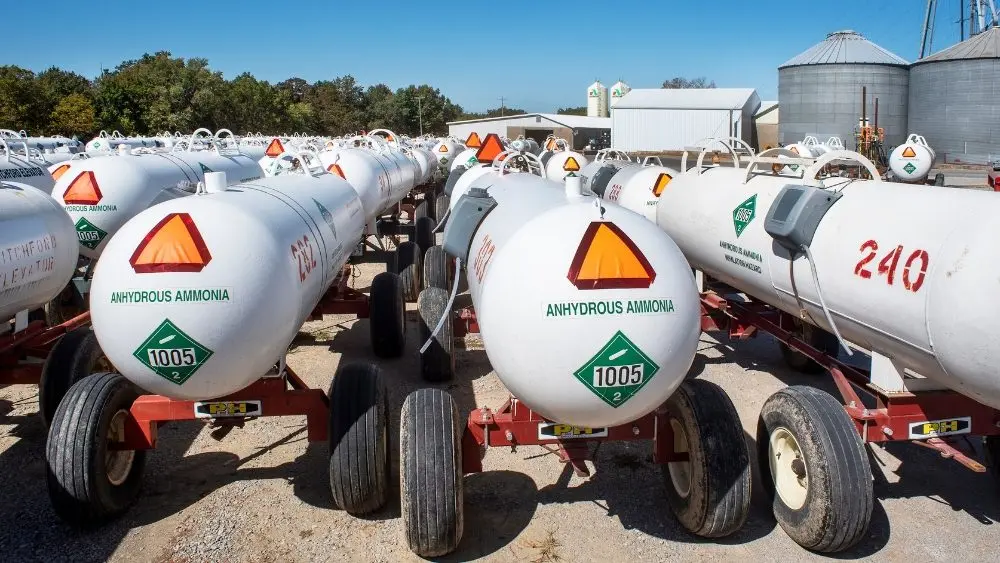
When the conflict in Iran escalated about a month ago, most Americans focused on oil prices and geopolitical tension. But for farmers across the Corn Belt, the Southern Plains, and beyond, the war set off a different kind of alarm — one measured not in barrels of crude, but in tons of urea, anhydrous, DAP, and potash.
Reuters captured the ground-level reality bluntly in a March 13 report: farmers in the U.S. and Canada, already worried about another year of low profits or losses, now face spring planting disruptions as they struggle to find fertilizer — with prices for any available supplies having spiked more than a third since the war in Iran paralyzed global trade.
And according to some of the most well-connected minds in the global fertilizer trade, what’s unfolding right now is not a temporary spike. It is a structural disruption with consequences that could echo through American agriculture for years.
A Market Already Under Pressure Before the First Shot Was Fired
The fertilizer market didn’t need a war to be fragile. It already was.
Melih Keyman, founder, president and CEO of Keytrade — one of the world’s leading fertilizer trading companies — put it plainly: “Even before the war, the world supply and demand balances were tight. They weren’t short necessarily, but they were tight and the prices were slowly going higher as we came closer to the spring season.”
The war, he said, changed everything — and dramatically so.
The Gulf’s Outsized Role in Global Supply
To understand why the Middle East conflict hits fertilizer markets so hard, you have to understand just how much of the world’s supply flows out of the Arabian Gulf.
Keyman laid out the numbers in stark terms. The region supplies roughly 34–35% of world urea, approximately 25% of ammonia, around 18% of DAP and MAP — and a staggering 45% of global sulfur supply. “These are extremely significant quantities,” Keyman said, “and they cannot be replaced from anywhere in any other form.”
Reuters reported that more than 30% of world nitrogen fertilizer exports, as well as critical fertilizer components like sulfur, pass through the now effectively closed Strait of Hormuz. Iran alone is a major player. Mike Castle, lead market intelligence project manager for StoneX, noted that Iran is the world’s number three urea exporter and number seven in ammonia exports. “They already have very serious infrastructure problems,” Castle said, pointing to strikes on Iran’s South Pars gas field. “We saw strikes on that gas field back in June that took them a really long time to recover from. And the big fear as we came into this was, boy, I hope that doesn’t happen again. And then it did.”
***Mike Castle with StoneX joined us to discuss on the Friday, March 20th, 2026 episode of Market Talk
The Qatar Wildcard: A Three-to-Five Year Problem
If Iran’s infrastructure damage was the opening blow, the strikes on Qatar’s Ras Laffan facility may prove to be the more lasting wound.
Castle described it as the development he had feared most going into the conflict. Qatar Energy, the state-owned company that owns the facility, has indicated the repairs could take three to five years. “This is not something that just — OK, the plant’s down for a few days,” Castle said. “This is a ‘oh boy, we’re losing a serious chunk of that gas supply.’ It’s not only the feedstock for their own production, but the LNG exports are also the feedstock for a lot of European production, a lot of Asian production.”
Keyman confirmed the downstream ripple effects are already being felt. India, one of the world’s largest fertilizer importers, has been forced to curtail gas usage to its ammonia and urea production units. “India is now delivering only 70% of the amount of gas the ammonia urea units need,” Keyman said, “and that loses about 800,000 tons per month of production in India.” In Bangladesh, he added, the situation is even more severe — with all plants reportedly down, representing approximately 3.7 million tons of annual production loss in a country that also imports an additional one million tons.
Castle flagged India as a critical headline to watch in the weeks ahead. If India steps forward with a new import tender — something the country does when domestic supplies run critically low — it could send prices surging even higher from already elevated levels. “If you see the headline ‘India tender announced,'” he said, “it’s not going to be great.”
***We also spoke with Melih Keyman, Founder, President, and CEO of Keytrade, one of the world’s leading fertilizer trading companies during the Thursday, March 19th, 2026 episode of Market Talk about the current global fertilizer situation.
The Sulfur Problem Nobody Is Talking About Enough
While nitrogen prices have dominated the headlines, Keyman flagged a quieter but equally serious crisis building in the phosphate market — one rooted in sulfur.
With 45% of global sulfur supply trapped behind the Strait of Hormuz, phosphate producers around the world face a critical feedstock shortage. “If 45% of the sulfur is missing, then somebody is not going to get enough sulfur to produce the MAP and the DAP and the SSP-TSP our global markets will need,” Keyman warned.
Castle echoed the concern, noting that phosphate has not received the attention it deserves relative to nitrogen. “Phosphate is one I don’t think is getting enough focus,” he said. Saudi phosphate supply is also trapped behind the Strait, and with China restricting exports, the options for buyers are narrowing fast. “All that’s really left is Russia and Morocco,” Castle said — and for American buyers, that creates its own set of complications.
China: Don’t Count on a Rescue
Just as the conflict was driving supply fears higher, China announced it would move to restrict fertilizer exports — a development that both experts said should not surprise anyone who has watched Beijing’s commodity playbook over the years.
“I hate to just feel like I’m saying I told you so,” Castle said, “but this was another thing I was worrying about in the lead up to this — does this war incentivize China to go back to stockpiling?”
Keyman was even more direct in warning farmers not to look to China as a potential savior. “China has its own agenda,” he said. “They want to keep the fertilizers at home so that the prices remain low. They do not want to export neither nitrogen nor phosphates.” While there is some hope in the trading community that China may open nitrogen exports by May and phosphate exports by August, Keyman cautioned against counting on it. “I wouldn’t count so much on Chinese coming as a savior.”
What This Means for American Farmers Right Now
Here at home, the picture is complicated — and the nuances matter.
On the nitrogen side, the U.S. is better insulated than most of the world, thanks in part to domestic production capacity and front-loaded imports. But insulation from a supply shortage doesn’t mean insulation from price pain. Castle noted that urea prices have roughly doubled compared to just a few months ago. “You’re competing with replacement cost,” he said. “And that replacement cost is very expensive because of what’s going on.”
When it comes to phosphate, Castle fears that’s not being talked about enough. He said that NOLA phosphate values have started to rally and he added that the U.S. has recently exported some phosphate to India — a sign that domestic supply is actively competing in the global export market, which ultimately pulls prices higher at home.
Castle added that “effectively, you know, to kind of simplify this is the farmer in the Midwest now has to compete with the export market to keep that supply here.”
Will Policy Fixes Help? Mostly No — At Least Not Today
With fertilizer prices now a mainstream political talking point on Capitol Hill — including calls from Senator Josh Hawley for an investigation into potential price-gouging and Agriculture Secretary Brooke Rollins indicating the administration is “looking at every potential avenue” to control costs — farmers might hope that Washington can provide near-term relief. Both Castle and Keyman were measured in their expectations.
On easing sanctions on Belarus, Castle said it does “genuinely nothing to help the problem.” On Venezuela as a potential alternative nitrogen source, he said the reality doesn’t match the hope — the infrastructure has been neglected for too long to flip any switches quickly. Reuters confirmed this assessment, noting that increasing fertilizer production in Venezuela’s stressed economy will be a challenge requiring billions of dollars and will not be a quick fix.
The one policy lever Castle said could make a real difference: removing countervailing duties on Moroccan phosphate. “Getting rid of those countervailing duties helps us go start to compete for those Moroccan tons — that’s not behind the Strait,” he said. “We export ammonia to them, we import the finished phosphates. It’s kind of a win-win.”
The Long View: This Doesn’t End When the War Does
Perhaps the most sobering message from both experts was this: even if peace broke out in the Middle East tomorrow, the fertilizer market would not quickly return to normal.
“Even if it stops tomorrow,” Keyman said, “until everything normalizes with production, clearing mines, opening the strait, and then 1,000 ships are trapped — for them to load and leave — it’s going to be a tough few months for our growers.”
Castle went further, arguing that the structural damage to Iran’s production infrastructure alone could have decade-long consequences. “It’s hard for me to imagine a world where whoever ends up in charge in Iran when this is all said and done is going to say, ‘Hey, what can I do to benefit long-term economics in Iran?'” he said. “It’s going to be what keeps me in power today. And typically that’s not infrastructure investment. Again, I think just a back and forth, two (military) strikes, probably will end up being years-long impacts in the nitrogen markets.”
What Farmers Should Do Right Now
Both experts converged on the same core message for farmers: stop waiting and start planning.
Keyman, who said he has been asked this question consistently for months, was direct: “I would suggest dropping the idea of last-minute buying. Waiting for the last minute and hoping for prices to come off significantly from current levels — under these market conditions, I would recommend against that.” His advice was to secure nitrogen first and foremost, and to treat fertilizer purchasing as a hedge rather than a speculation.
Castle framed the risk in practical terms, noting that some farmers who planned fall applications and decided to wait for spring are now facing not just higher prices — but potential supply allocation issues. “You may physically not have the supply,” he warned. His broader advice: start treating fertilizer markets the way you treat grain markets. “Everyone’s got a grain marketing plan. Start doing this to fertilizer too.” He encouraged farmers to look at the relationship between input costs and grain prices together, and to use buying opportunities on the input side as a trigger to simultaneously lock in grain sales.
The Bottom Line
Keyman may have said it best when he summed up the broader environment: “Our business depends on weather and governments — and these are the two most unreliable things on the globe.”
For American farmers heading into spring planting, that uncertainty is now the operating reality of the fertilizer market. The experts are not predicting doom — but they are clear that the era of cheap, readily available fertilizer is under serious and lasting threat. The producers who adapt their planning, purchasing, and risk management strategies to reflect that new reality will be far better positioned than those who wait for a market that may not return.