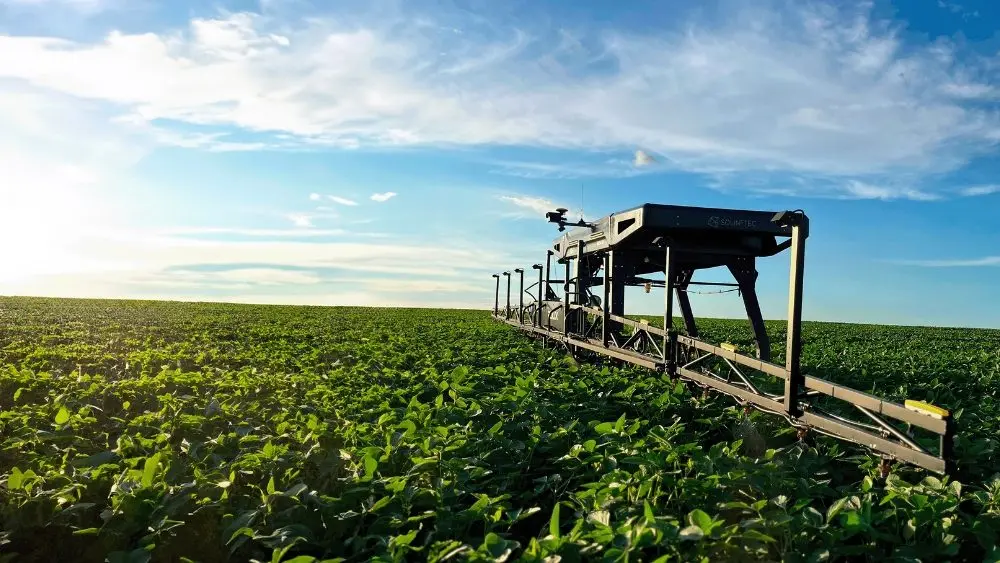
There has been a rapid expansion of robotics and AI use in our daily lives and agriculture is not exempt. We have seen a large jump from development to use in our fields and on our farms in the last several years.
One of the companies helping to develop and lead the charge is Solinftec. They entered the season with 243% year-over-year U.S. acreage growth and more than 100 autonomous Solix robots deployed across American farms — a scale that signals agricultural robotics is moving beyond pilot programs and into sustained commercial adoption.
“We have seen a lot of advancement in regard to the technology delivering value to the grower,” says Taylor Wetli, US Commercial & Business Development Manager for Solinftec. “It feels like the 15 years before we were talking a lot about different technologies, but it wasn’t really delivering that exact value for the grower. I think with AI and robotics, we’re actually starting to meet some of the challenges that the customers are facing.”
Regarding AI use and growth, he adds that “as we think about large language models and AI, I see that as well as a big advancement just at a macro level, whether that be with AIs like Google’s Gemini or chat GPT, I see integrations in the future that are going to allow a lot of what we’re doing on the farm to be able to be optimized and kind of a buzzword, but really be able to track that better and have new insights through these large language models as well.”
One of Solinftec’s key areas of focus the last several years has been their SOLIX platform. Wetli says it is a scouting sprayer that was really “born from having customers that were using our software and understanding where their overall fleet was and kind of becoming more efficient operationally. But what we were missing was what was going on at the agronomic level.”
He adds that “if you think back 100 years, farms were smaller and the farmer was able to constantly go to the field. While they’re there, they’re able to see disease pressure, insects, weeds, whatever that may be. But as we’ve scaled, we’re unable to make so many passes in the field. And so that’s what SOLIX was born from, having something via a robot that’s constantly there, understanding what is happening in the field. In addition to that, also executing on tasks, such as spraying weeds when they’re small and so on. The platform is a solar-powered robot with a 40-foot boom on the front, using our own targeted application to detect where those weeds are and just spray those weeds.”