Photo courtesy of Bethany Baratta, Iowa Soybean Association.
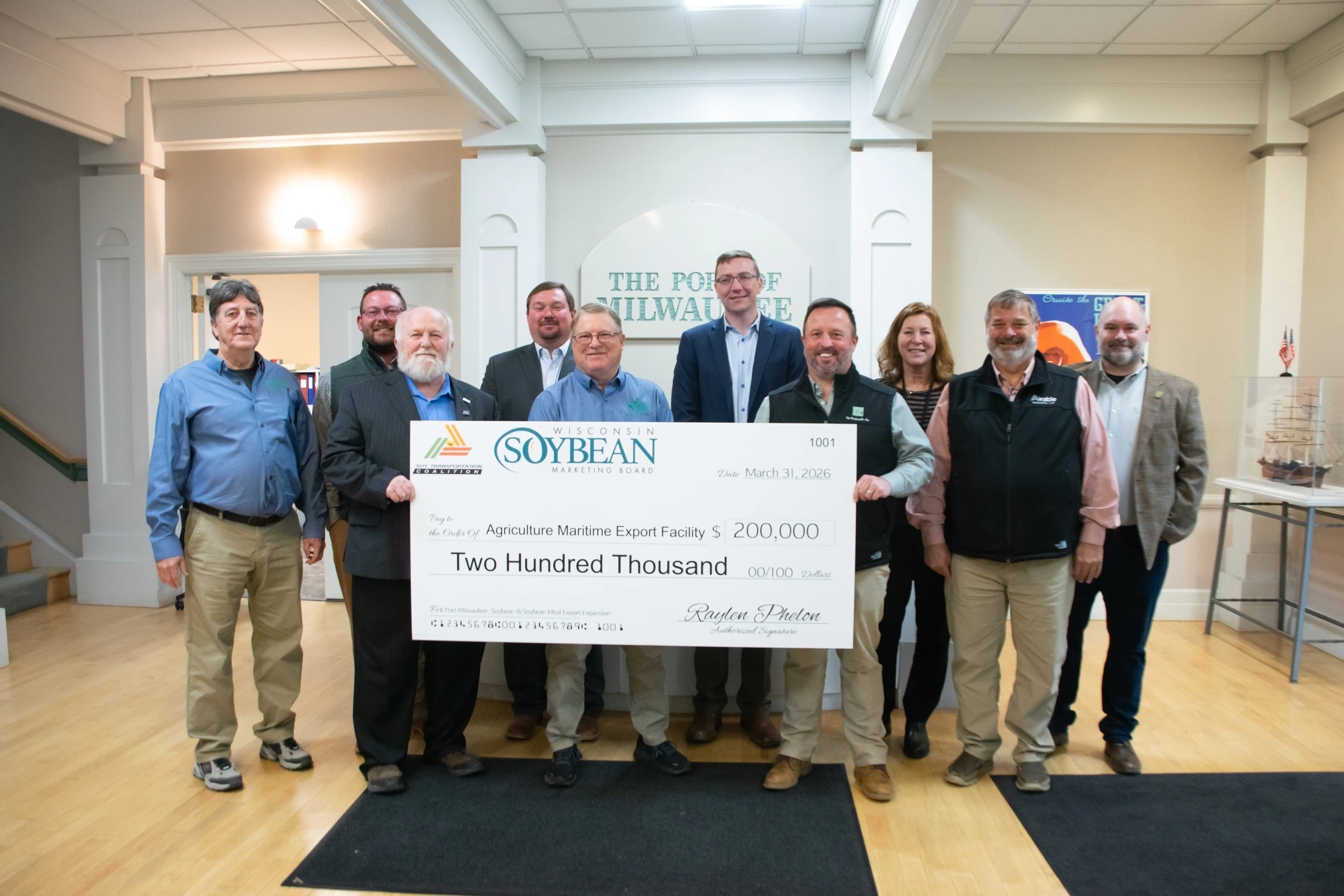
Ankeny, Iowa — Soybean farmer leaders were in Milwaukee on March 31st in order to present a ceremonial check in the amount of $200,000 for the Phase II expansion of the Agriculture Maritime Export Facility at Port Milwaukee. The facility, owned and operated by The DeLong Company, originally became operational in 2023. The Phase II expansion, which will enhance the capacity to export U.S. soybeans and soybean meal, was completed on April 2nd, 2026. In addition to officials from the Soy Transportation Coalition and The DeLong Company, ceremony attendees included representatives from Port Milwaukee, the Great Lakes-St. Lawrence Seaway Development Corporation, the Wisconsin Department of Agriculture, Trade, and Consumer Protection, the U.S. Maritime Administration, and the Wisconsin Department of Transportation.
By investing in this project, soybean farmer leaders are addressing several major priorities of the soybean industry:
- Increasing soybean meal export capacity: One of the significant developments in the U.S. soybean industry continues to be the investment in processing facilities in order to produce more soybean oil for renewable fuels. The additional production of soybean oil will result in an additional production of soybean meal. While much of this additional soybean meal will be consumed by the domestic livestock industry, it is increasingly essential to invest in additional export capacity to connect with international markets. The Phase II expansion will significantly enhance the capacity for exporting U.S. soybean meal and soybeans to global customers.
- Increasing resilience of the supply chain: One of the axioms related to the supply chain is
- to avoid “putting all your eggs in one basket.” While the Great Lakes-St. Lawrence Seaway is not a dominant launching point for soybeans and soybean meal onto the international marketplace, it can and should play a more prominent role. The more the U.S. soybean industry can diversify its supply chain – including by investing in Great Lakes infrastructure – the better positioned soybean farmers will be to remain profitable in an often unpredictable and uncertain future.
- Diversifying international markets: Given the significant challenges confronting soybean exports due to the curtailment of the Chinese market, it is imperative to pursue “base hit” marketing opportunities for soybean meal and soybeans. The identified markets for the Agriculture Maritime Export Facility at Port Milwaukee via the Great Lakes-St. Lawrence Seaway are primarily Europe, North Africa, the Mediterranean, and the Middle East. In addition, the facility also affords the opportunity to load barges twelve months of the year and ultimately connect via the Illinois and Mississippi Rivers to gulf export terminals.
Phase I of the Agriculture Maritime Export Facility was opened on July 18th, 2023, and primarily has been used to export DDGs to international markets via the Great Lakes-St. Lawrence Seaway. Soybeans and soybean meal have also been exported from the facility. This facility is capable of loading vessels between 8,000 – 22,000 metric tons. Phase II of the project is resulting in the construction of two grain storage silos, electrical service upgrades, and additional handling equipment, which will significantly enhance the capacity to export additional soybean meal and soybeans. The Phase II project expansion was the recipient of a $9.3 million grant through the U.S. Maritime Administration’s Port Infrastructure Development Program (PIDP). According to the U.S. Maritime Administration, PIDP grants are awarded on a competitive basis to projects that improve the safety, efficiency, or reliability of the movement of goods into, out of, around, or within a port.
In presenting the ceremonial check to officials with The DeLong Company, Raylen Phelon, a farmer from Melvern, Kansas, and chairman of the Soy Transportation Coalition and commissioner on the Kansas Soybean Commission, explained, “In order for U.S. soybean farmers to be successful in the international marketplace, we not only require abundant supply and robust demand. We also require a transportation infrastructure that can connect what soybean farmers grow with our customers throughout the world. The DeLong Company’s Agriculture Maritime Export Facility at Port Milwaukee is excellent example of an investment that will help farmers remain competitive. It is for this reason that farmer leaders from the Soy Transportation Coalition and the Wisconsin Soybean Marketing Board decided to invest $200,000 to help underwrite some of the pre-engineering, design, and research costs associated with this important project. We would like to express our appreciation to The DeLong Company, Port Milwaukee, the U.S. Maritime Administration, the State of Wisconsin, and the Great Lakes St. Lawrence Seaway Development Corporation for investing in and supporting the supply chain that allows farmers like me to be successful.”
Andy Bensend, a soybean farmer from Dallas, Wisconsin, and director on the Wisconsin Soybean Marketing Board, the Soy Transportation Coalition, and the United Soybean Board, explained during the ceremony, “Investments like The DeLong Company’s Agriculture Maritime Export Facility at Port Milwaukee allow farmers in Wisconsin and throughout the region to benefit from waterborne transportation, which is the most economical and environmentally sustainable mode. The Wisconsin Soybean Marketing Board and the Soy Transportation Coalition are proud to join in on this important expansion.”
“We sincerely appreciate the support from U.S. soybean farmers on this important project,” said Brandon Bickham, Vice President of Exports for The DeLong Company. “We need to continue to promote ways to diversify our supply chain to connect with international customers. The Agriculture Maritime Export Facility helps achieve this. We look forward to continuing to work the Soy Transportation Coalition, the Wisconsin Soybean Marketing Board, and the broader soybean farmer community in making the U.S. soybean industry to most competitive in the global marketplace.”