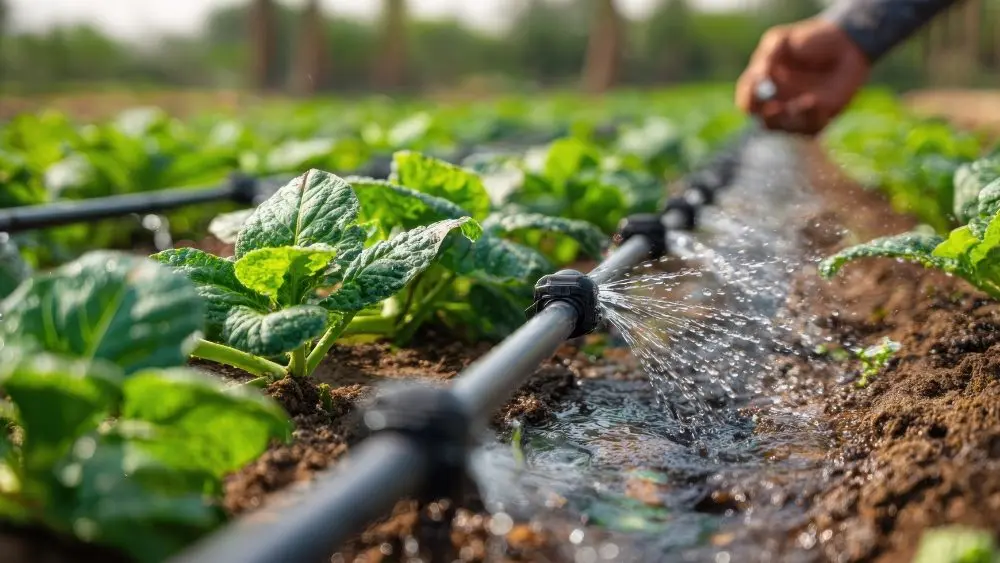
Controlled environment agriculture (CEA) is still a smaller part of U.S. crop production than open-field farming, but it is growing fast. USDA’s Economic Research Service reports that the number of U.S. controlled environment agriculture operations more than doubled to nearly 3,000 between 2009 and 2019, and crop production from those systems rose 56 percent over the same period. This rapid rate of growth puts more pressure on CEA operators to run precision-based operations, especially when margins, labor, and input costs are volatile.
As greenhouse, hydroponic, and indoor farms get larger, irrigation has to do more than simply move water. It also has to deliver nutrients evenly, hit the right targets quickly, and continue to do this work reliably, cycle after cycle. Stabilization time becomes an even more exacting factor as cycles shorten.
In these systems, growers do not have the safety net of hoping field conditions will smooth out any irregularities. With larger and more complex CEA environments, not only are the facilities magnified, but so is every aspect of the operating systems. Even the smallest variations in nutrient delivery can quickly affect crop quality and yield, and also impact crew workloads.
That is one reason pH and EC matter so much in CEA. Oklahoma State University Extension notes that pH affects nutrient availability, while EC gives an estimate of nutrient content in the solution. In hydroponic systems, those numbers are critical to track and interpret. This data tells a grower whether the crop is getting the right feed at the precise concentration.
Having confidence in irrigation behavior becomes more urgent as facilities scale. With more irrigation events, larger, multi-zone operations, and tighter crop schedules, there is less room to accommodate slow responses in flow or uneven mixing. A system that did the job fine in a smaller house can turn into a cumbersome source of extra checks, manual adjustments, and lost time in a larger one.
Many growers are finding that upgrades inside existing facilities, instead of starting from scratch, make more sense economically and operationally. A recent industry outlook reported that some of the recent shifts in CEA of moving away from new indoor construction and toward retrofitting and improving current greenhouse structures is driven in part by high energy costs, property costs, and infrastructure expenses.
This is a trend that is likely to become more standard practice as it reflects how growers actually make decisions. Most are not interested in replacing working infrastructure but would prefer equipment that fits within the operation they already have and solves real problems. More even nutrient delivery, faster correction when targets drift, less maintenance, and fewer day-to-day workarounds bring significant efficiencies to the crews.
Technologies that bring these attributes will support this new era of CEA expansion. Growers need fertigation systems that are more stable, more precise, easier to maintain, and easier to install without causing expensive production interruptions. When a system can help consistently hit targets and reduce manual corrections, that value extends far beyond the equipment room.
CEA will continue to evolve, but the basics will not change. Growers still need consistency, efficiency, and reliable crop performance. As these operations grow, precision irrigation becomes one of the clearest ways to protect all three.