
Rising fertilizer costs are once again tightening margins for U.S. farmers, but new data and industry reaction suggest the problem runs deeper than a single season—raising concerns about long-term supply, market structure, and the future of U.S. agriculture.
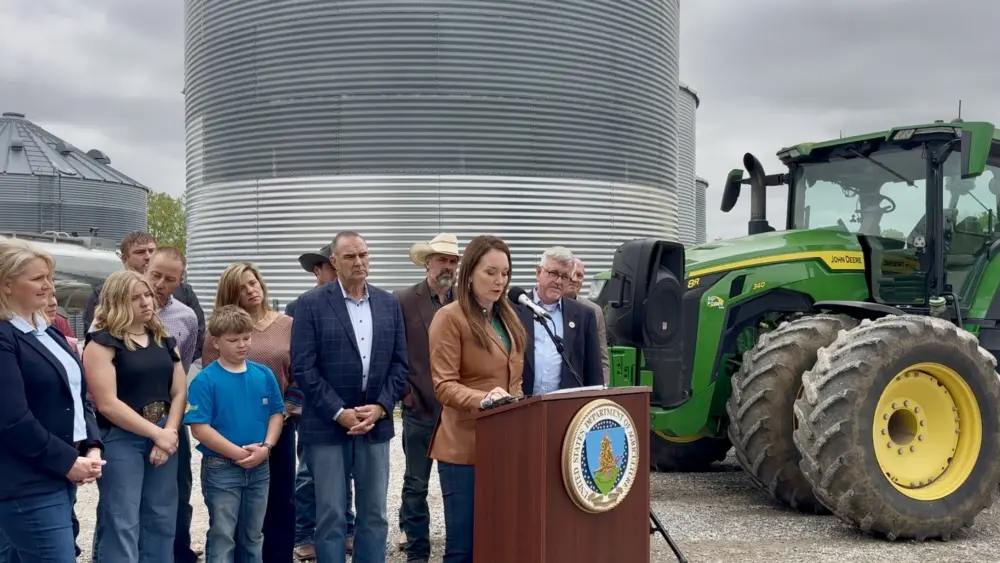
Speaking during a recent press event, U.S. Department of Agriculture Secretary Brooke Rollins outlined what she described as an urgent, multi-agency response to surging input costs. She pointed to sharp increases in key fertilizer inputs, noting urea prices have jumped roughly 50 percent in the past month, while ammonia is up more than 30 percent.
Although those levels remain below the peaks seen in 2022, the speed of the increase is creating immediate strain for producers already operating on thin margins. That pressure is being compounded by global instability, particularly disruptions tied to conflict in the Middle East and shipping challenges through the Strait of Hormuz—one of the world’s most critical trade corridors for fertilizer and energy inputs.
Recent data backs up what farmers are feeling on the ground. A nationwide survey from the American Farm Bureau Federation found roughly 70 percent of farmers report they cannot afford all the fertilizer they need this season. At the same time, a separate survey from the National Corn Growers Association shows growing anxiety not just for 2026, but for the 2027 crop year, with nearly twice as many farmers expressing greater concern about next year compared to the current season.
For Jed Bower, a corn grower in Ohio and president of the NCGA, the situation has reached a breaking point.
“The cost of fertilizer is completely out of sight,” Bower said on a recent episode of Agriculture of America, warning that the industry is nearing “big problems” if structural issues are not addressed.
Those concerns are reflected in both affordability and availability. According to NCGA, only about 60 percent of farmers report having nitrogen fully secured for the 2026 growing season, while phosphate availability sits at roughly 64 percent. On a “currency of corn” basis, it now takes approximately 185 bushels of corn to purchase one ton of urea—the highest level on record—underscoring how falling commodity prices are magnifying the burden of rising inputs.
Recent American Ag Network coverage reported regional disparities further complicate the picture. Midwestern producers, who typically pre-book fertilizer for corn and soybean rotations, report higher rates of securing inputs ahead of planting—about 67 percent. But even in the Midwest, nearly one in three farmers entered the season without full fertilizer coverage. In contrast, only 19 percent of Southern producers pre-booked fertilizer, along with about 30 percent in the Northeast and 31 percent in the West, leaving those regions more exposed to in-season price spikes.
That same AAN coverage indicates smaller farms are particularly vulnerable. Operations under 500 acres across all regions reported significantly lower pre-booking rates than larger farms, increasing their exposure to volatile spring markets and raising the risk of reduced application rates, lower yields, and tighter margins.
During the Missouri press conference, Rollins said the current situation reflects both long-standing structural challenges and more recent global shocks. A lack of competition in the fertilizer industry has contributed to higher prices over time, she said, while geopolitical tensions have intensified supply disruptions. That combination, she warned, has brought the issue to a critical point.
“This is indeed a matter of national security,” Rollins said.
Industry groups and policy advocates are increasingly echoing that concern. According to Farm Action, the fertilizer market is highly concentrated, with four firms controlling more than 80 percent of nitrogen production and just two companies controlling over 90 percent of phosphate and potash capacity. That level of consolidation, the group argues, allows global disruptions to translate into rapid and sustained price spikes for farmers, while limiting transparency around pricing and supply.
“Without structural reforms, this dynamic risks becoming cyclical,” the organization warned in a letter to Congress, pointing to a pattern where taxpayer-funded relief flows through farmers and ultimately into concentrated input sectors.
Rollins acknowledged those concerns, noting USDA has partnered with the U.S. Department of Justice to monitor fertilizer markets, with a renewed focus on potential price gouging. She said she recently met with Acting Attorney General Todd Blanche to continue those discussions, alongside ongoing conversations with fertilizer company executives. Those conversations appear to be part of a broader push by the administration to stabilize prices in the near term.
At the same time, policy debates are intensifying around trade measures and market access.
Lawmakers are beginning to respond to those transparency concerns. Senator John Thune introduced the Fertilizer Transparency Act of 2026, bipartisan legislation that would require the U.S. Department of Agriculture to collect and publish weekly fertilizer price data from manufacturers. Currently, USDA relies on an annual voluntary survey of prices paid by producers. Thune said the bill is designed to give farmers clearer market signals as they navigate volatile input costs, while supporters, including the South Dakota Corn Growers Association, argue greater transparency could improve competition and help producers make more informed purchasing decisions.
Countervailing duties on phosphate imports from Morocco and Russia remain a point of contention, with companies like Mosaic Corporation and J.R. Simplot supporting their continuation and others like Nutrien suggest lifting them could ease costs. Bower said the uncertainty highlights a broader question facing the industry: whether policy will enable new competition or allow further consolidation.
“The key is going to be… can we incentivize some new players to come to the market to drive some competition?” he said.
While those longer-term questions play out, USDA is moving forward with immediate actions. Among them, the administration has extended a waiver of the Jones Act for an additional 60 days to increase shipping flexibility. By temporarily lifting restrictions that require U.S.-built and U.S.-crewed vessels for coastwise trade, officials say the move is intended to speed the movement of fertilizer between ports and help address regional shortages driven by global disruptions and recent price spikes.
Other USDA actions include opening new fertilizer import channels from Venezuela, and reinstating potash and phosphate on the U.S. critical minerals list to encourage domestic production.
Rollins also emphasized a broader strategy to reshore fertilizer manufacturing, reducing reliance on imports from countries like Russia and China. Working with the U.S. Department of Commerce, the administration is identifying opportunities to accelerate investment in new domestic fertilizer plants and streamline permitting timelines that can traditionally take years.
A key part of that strategy hinges on leveraging the nation’s natural gas supply. Rollins pointed to the U.S. transition to energy independence in recent years as a model, noting that abundant domestic LNG could be used to produce nitrogen fertilizer—if sufficient infrastructure is built.
“We now have the resources in America,” she said. “We just have to build the facilities.”
Even under an accelerated timeline, however, Rollins said meaningful increases in domestic production could take 12 to 18 months or longer to come online, leaving farmers to navigate continued volatility in the meantime.
Some companies are already stepping in with short-term measures. Rollins cited cooperation with domestic producers like CF Industries, which has indicated it may delay maintenance and hold prices steady to support farmers.
Still, for many producers, the immediate reality is difficult. While recent federal relief payments have potential to provide support, a growing share of those dollars is being absorbed by steadily rising input costs. Rollins told American Ag Network reporter Corryn La Rue that while farmers ultimately decide how to spend those funds, many who had planned investments in infrastructure or expansion are now redirecting that money toward fertilizer and other essential inputs.
“We’ve moved out tens of billions of dollars in payments,” she said. “But now, a lot of that is likely going straight into input costs.”
Rollins also pointed to broader economic pressures facing the farm sector, arguing that while federal assistance has helped stabilize overall income levels, it has not meaningfully improved profitability for producers, particularly in row crop agriculture. She said farm income has largely remained flat in recent years, even as input costs continue to rise across nearly every category.
“Why is it tracking that every time we send government payments out to the farmers, they barely survive, but these big companies continue to make record profits?” Rollins added, framing the trend as part of a broader imbalance in agriculture’s cost structure. She said those dynamics raise fundamental questions about pricing power and market behavior across the input sector.
As a result, many farmers report being in the red for multiple consecutive years, underscoring the ongoing financial strain across much of U.S. agriculture.
With fertilizer purchasing decisions often made months in advance, today’s disruptions are already shaping the outlook for 2027. Survey data suggests that uncertainty around both price and availability is accelerating, raising the risk of tighter supplies and higher costs in the next production cycle.
As policymakers prepare additional announcements in the coming weeks, the challenge will be balancing immediate relief with long-term reforms—addressing not only supply chain disruptions, but also the structural forces driving repeated price shocks.
For farmers heading into planting season, the stakes are immediate. But the decisions made now, across government and industry, could determine whether fertilizer remains a recurring crisis—or becomes a more stable foundation for American agriculture.