URBANA, Ill. – For decades, livestock producers and evaluators have relied on trained eyes to judge how animals move. Now, researchers in the College of Agricultural, Consumer and Environmental Sciences at the University of Illinois Urbana-Champaign aim to turn those visual assessments into measurable data, helping improve cattle health, longevity, and management.
Josh McCann, associate professor in the Department of Animal Sciences, is leading a new USDA National Institute of Food and Agriculture-funded project focused on understanding cattle skeletal structure and movement through advanced imaging technology.
The project, called “Cattle Mooves,” (and yes, the spelling is intentional), brings together expertise in livestock evaluation and precision technology. The playful name reflects the project’s central focus: understanding exactly how cattle move.
“As long as we’ve raised cattle, we’ve wanted to understand their structure,” McCann said. “We can measure a lot of things really well, like how much they weigh and how much they eat. But if we can’t measure something, like structural soundness, it’s really hard to manage.”
Turning observation into measurable data
Structure, which is essentially how an animal’s skeleton is aligned and moves, plays a major role in cattle longevity and productivity. While producers and judges routinely evaluate traits like stride length and joint angles, those assessments have traditionally been subjective.
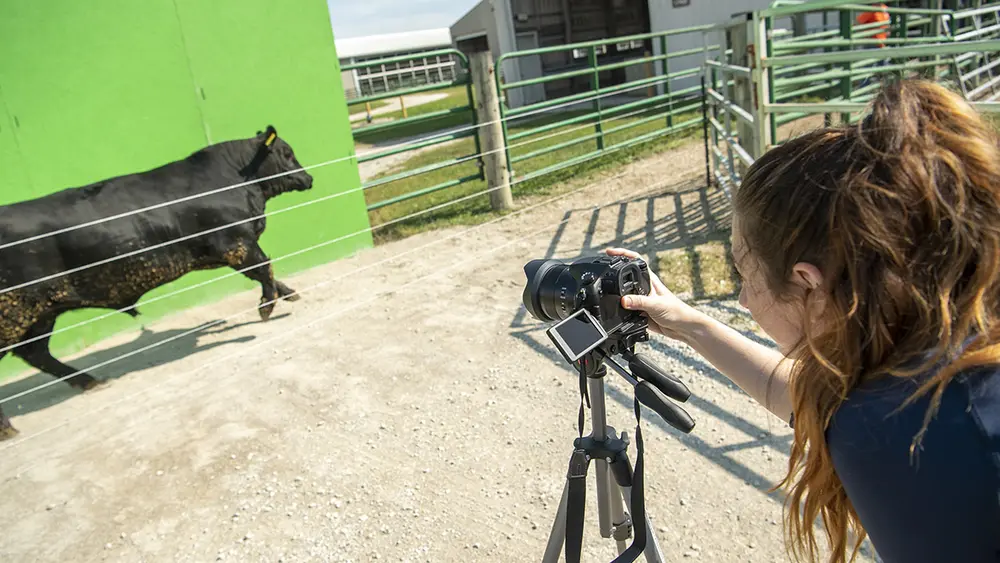
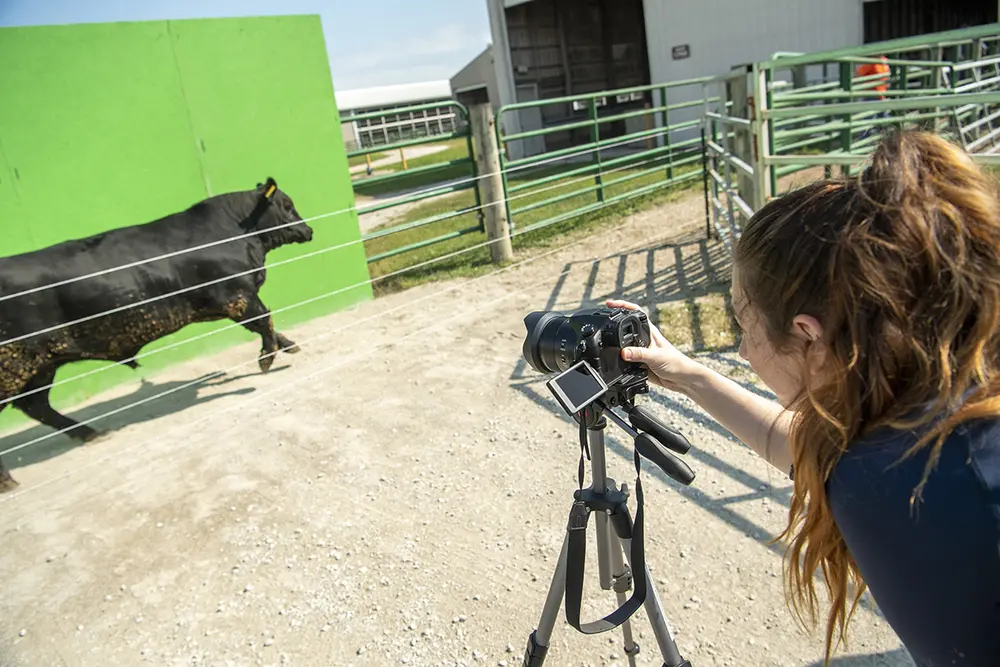
McCann’s team is working to change that using 3D imaging and computer analysis. Specialized cameras capture cattle in motion, allowing researchers to quantify traits like stride length and limb angles with precision.
“We’re trying to measure the same things people look at when they evaluate animals visually,” McCann said. “The difference is now we can quantify it.”
To do this, researchers combine marker-less imaging, where algorithms track joints and hooves from video, with marker-based systems that provide highly accurate reference data by placing markers directly on the cattle.
Together, these approaches turn visual observations into measurable data that can inform both management and genetic selection.
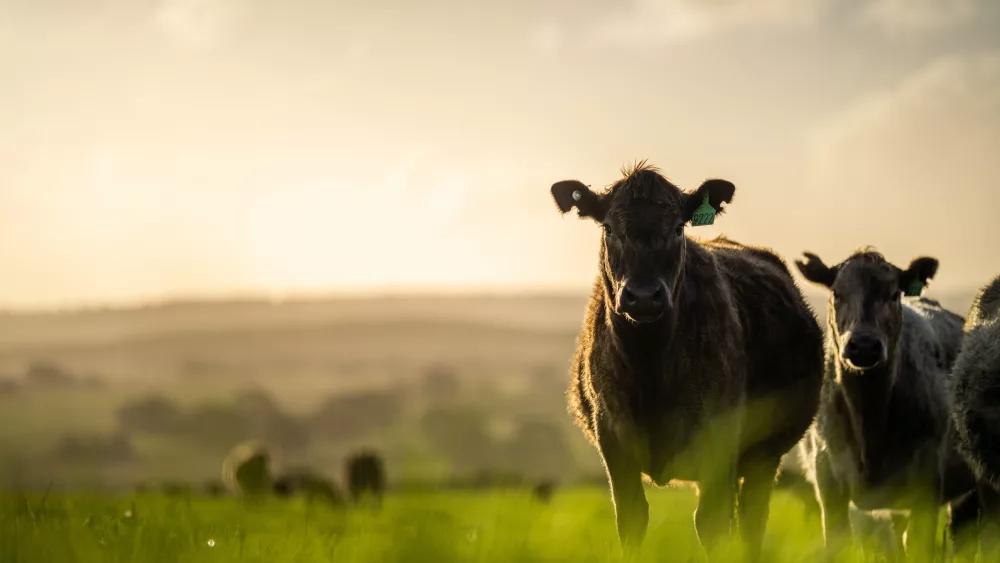
“Our feedlot cattle are used to just living in their pens,” McCann said. “Then we kind of turn them into movie stars for a moment while we capture the data.”
One key application is improving how producers identify and prevent lameness, a condition that impacts both animal welfare and productivity. Capturing that data, however, isn’t always straightforward.
“Preventing lameness is a lot better than treating it,” he added. “If we can identify structural traits that indicate potential problems early, we can manage animals in ways that help prevent those issues from developing.”
Beyond immediate management, the data could also support long-term genetic improvement.
“If we’re selecting heavily for traits like growth or meat quality, but not paying attention to structure, there’s a good chance we’re losing ground there,” McCann said. “Being able to measure structure opens up an opportunity for improvement.”
Training the next generation
While much of the project focuses on research, education is also a major component. Approximately one-third of the grant supports training students and expanding the awareness of emerging technologies in livestock production.
The project will involve undergraduate students working directly with the research team, particularly those with engineering or computer science backgrounds; the goal is to expose technically skilled students to challenges within animal agriculture.
“We have a lot of engineering students with incredible technical expertise,” McCann said. “We want them to see that there are meaningful problems in agriculture where those skills can make a real difference.”
Another major effort will focus on developing curriculum for high school agricultural education programs. The research team plans to create free educational materials introducing students to precision livestock management, which is a rapidly emerging field that combines animal science with technologies such as sensors, computer vision, and data analysis.
“The precision technology side of agriculture has matured really quickly in crops,” McCann said. “But in livestock, it’s still very new.”
By developing an accessible curriculum and sharing it with agricultural educators across Illinois, and possibly beyond, the team hopes to expose thousands of students to career opportunities that combine technology and animal agriculture.
As research progresses, the team expects both the technological and educational components of the project to continue evolving.
“We’ve done a lot of work already,” McCann said. “But in many ways, we’re just getting started.”
Research in the College of ACES is made possible in part by Hatch funding from USDA’s National Institute of Food and Agriculture.