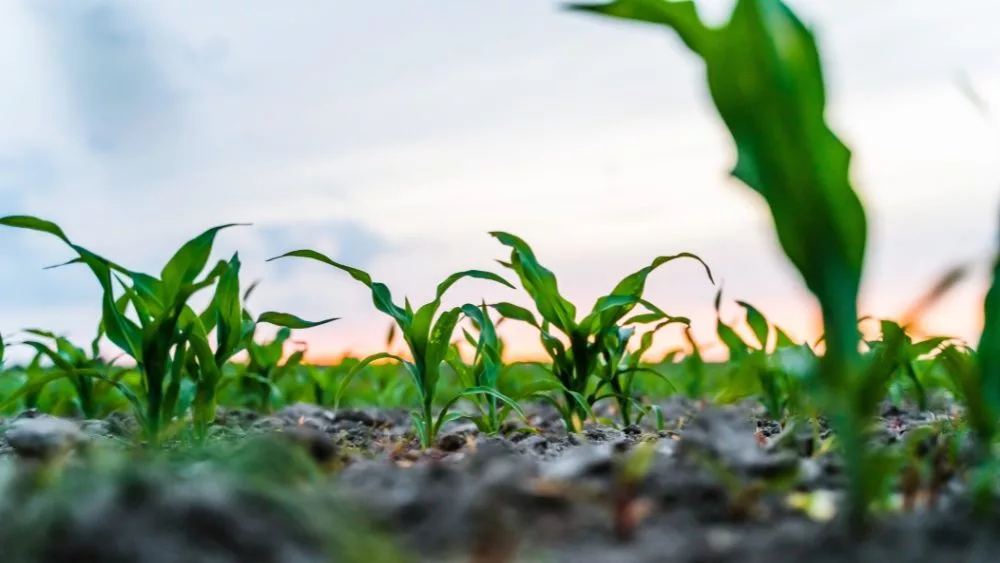
Stand assessments help identify planting issues, estimate yield potential, and make informed replanting decisions.
For corn, stand is typically determined by measuring a fixed length equal to 1/1000th of an acre, which varies by row width. In 30-inch rows, this distance is approximately 17 feet 5 inches. To estimate plants per acre, count the live plants within the measured length and multiply that number by 1,000. Repeating this process in multiple locations across the field provides the most accurate stand representation.
When counting the live plants, look across the rows for large gaps and variation in plant maturity, because quantity is important, but quality is crucial to yield. Plants with delayed emergence or development are at a competitive disadvantage with larger plants in the stand and can negatively impact yield.
“Ideally, we want every plant to be at the same growth stage,” said Derek Bowman, Pioneer product agronomist. “If we start getting a lot of runts out there, or plants that are behind a growth stage or two, it could affect our overall yield.”
Uneven emergence has several potential causes, such as:
- Variation in soil moisture
- Poor seed-to-soil contact due to work or planting into wet soil
- Variation in soil temperature caused by uneven crop residue distribution
- Soil crusting
- Insects and disease
Uneven emergence may not appear immediately, but as the plants start to rely on the soil through their nodal root system, slow development from unfavorable conditions can emerge. Digging up a few plants can help identify planter malfunctions or unfavorable conditions that can be addressed the following season.
“We’re not necessarily evaluating for replant, we’re just looking at what we can maybe do better in the future or reestablish our yield goal and yield potentials in these fields,” said Ryan Bates, agronomy innovation manager. “I encourage you to go out there, make sure you dig it up, and look at that root system.”
If the concerns cannot wait for next season, replanting can supplement the lost yield, but the increased yield would need to cover all replanting costs such as extra herbicide and tillage, planting and increased grain drying. The possibility of an autumn freeze prior to physiological maturity and the susceptibility of late-planted corn to summer drought, disease and insects must also be considered.
Uneven emergence is not the only reason to consider replanting. If unfavorable weather conditions such as flooding or hail can damage part of the field, the affected area needs to be addressed separately from the rest of the field a few days after the incident.
When replanting, research indicates a switch from a full-season to an early maturity hybrid if replanting after May 25 and from a mid-maturity to an early maturity hybrid if replanting after June 3.