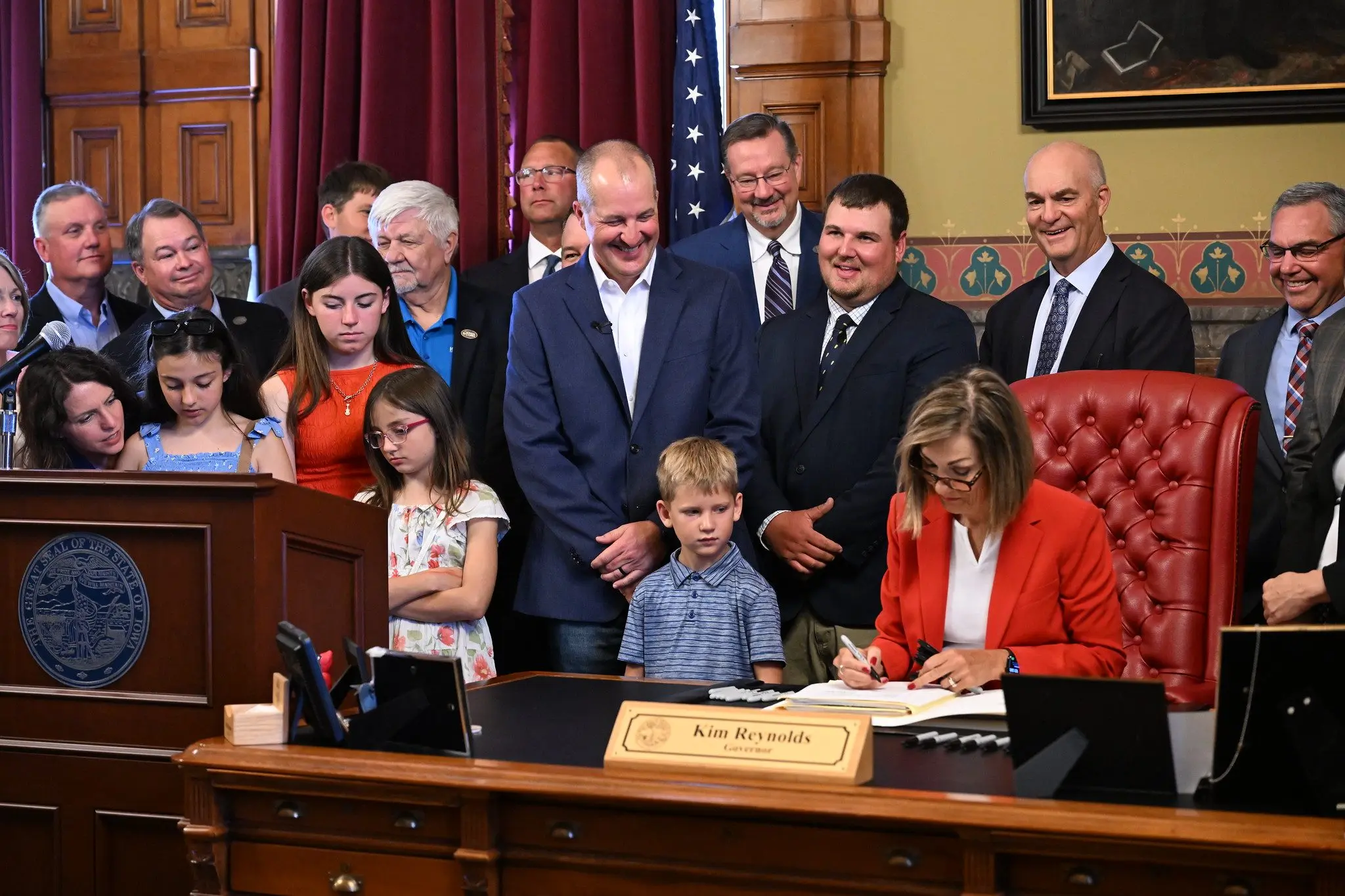
DES MOINES, Iowa – Iowa Secretary of Agriculture Mike Naig joined Gov. Kim Reynolds this week as she signed House File 2771, the Agriculture and Natural Resources budget, which includes new investments in water quality aimed at supporting Farm to Faucet infrastructure improvements across the state.
Secretary Naig and Gov. Reynolds both highlighted the legislation as a bipartisan effort focused on expanding water treatment capacity and strengthening both rural and urban water quality practices without increasing taxes on residents.
The Farm to Faucet legislation restructures the state’s water excise tax distribution formula and directs strategic one-time investments that officials say will generate nearly $320 million in water quality funding over the next 12 years. According to state officials, the funding will be distributed to support what they describe as the state’s most effective programs as well as areas of urgent infrastructure need.
“Thank you to Gov. Reynolds and legislators of both parties for supporting this balanced approach — working up and downstream — to improve water quality in Iowa without increasing the tax burden on hardworking Iowans. By re-directing existing dollars to fund projects and programs that are proven to work, we’re able to modernize Iowa’s water treatment infrastructure from the farm to the faucet,” said Secretary Naig. “We have made tremendous progress working with farmers and landowners and hundreds of public and private partners to incorporate responsible farming practices, but there’s no finish line when it comes to conservation. We’re going to keep leveraging new research and technologies and identifying more partners to work alongside us to make meaningful changes on the land, which will lead to real, measurable changes in water quality.”
House File 2771, including the updated water excise tax distribution formula and related appropriations, is set to take effect on July 1, 2026.
The legislation provides the Iowa Department of Agriculture and Land Stewardship (IDALS) an estimated $52 million in new funding over 12 years. That funding will support conservation practices such as cover crops, edge-of-field buffers, wetlands, and grazing systems in the Greater Des Moines watershed, which spans 22 counties across northwest, north central and central Iowa. State officials say targeting this region is intended to maximize upstream impact while improving source water quality that ultimately flows into the Central Iowa Water Works service area.
It also allocates an additional $500,000 per year to the Iowa Department of Natural Resources (DNR) to expand the statewide water quality monitoring network. Those funds can be used for real-time monitoring technology, including sensor-based systems, bringing total state investment in water monitoring to $3.5 million annually.
The measure further utilizes a fund balance from an underutilized program to support a one-time $25 million investment in Central Iowa Water Works. That funding is intended to expand infrastructure and increase nitrate removal capacity over the next three years, according to state leaders.
In addition, the legislation increases annual funding and provides a one-time $8 million investment to the Iowa Finance Authority’s (IFA) Wastewater and Drinking Water Treatment Financial Assistance Program, which issues grants to communities upgrading water infrastructure. It also raises the maximum grant award from $500,000 to $1 million.
The bill also establishes $10 million in funding for the creation of the Rural Iowa Infrastructure Bank, a revolving loan program offering 1 percent interest loans to small and mid-size communities with populations under 11,000 to support water treatment infrastructure projects.
Officials say farmers across Iowa continue to adopt conservation practices outlined in the Iowa Nutrient Reduction Strategy, including cover crops and constructed wetlands, to reduce soil erosion, filter nitrates and improve water quality. State leaders describe the effort as part of a broader commitment to responsible farming practices intended to benefit both agricultural production and local communities.
“There’s more work to do,” officials noted, but Iowa farmers are accelerating the pace of conservation adoption.
The State of Iowa invests nearly $100 million annually in water quality improvement efforts, with an additional $500 million in federal support flowing into related initiatives each year, according to state data.
In 2024, Iowa farmers planted nearly 4 million acres of cover crops, a significant increase from fewer than 400,000 acres just a decade ago. Officials also report that farmers are constructing nitrate-reducing wetlands designed to capture runoff before it leaves fields, reducing nitrate levels by as much as 90 percent. More than 150 wetlands have been constructed statewide, with construction activity nearly tripling over the past four years compared to the previous two decades.
Additionally, nearly 500 nitrate-filtering buffers have been installed along field edges to intercept and treat water before it enters waterways. State reports indicate these practices are being implemented at roughly five times the rate seen in the previous decade.
Iowa State University leads measurement and reporting efforts for the Iowa Nutrient Reduction Strategy. Progress is tracked through a Logic Model that evaluates funding levels, outreach efforts, practice adoption, and resulting changes in water quality over time. Public-facing dashboards are available on the Iowa Nutrient Reduction Strategy website.