MANHATTAN, Kan. – Warmer spring temperatures mean that crops begin to sprout from the ground. However, with these warmer temperatures, crops are not the only things that are greening up; weeds are too. A K-State researcher said that now is the time to start scouting for weeds.
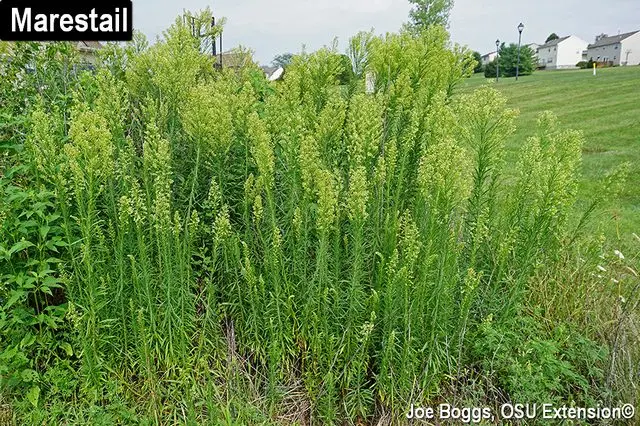
“Marestail is a winter annual weed that typically comes up either in the fall or spring,” said Sarah Ganske, a weed specialist with K-State Extension. “Marestail can be a big problem in some situations, as it has fluffy little seeds that can fly around and go long distances – plus it is hard to control once it bolts (grows tall).”
Marestail, commonly known as horseweed, emerges as a rosette. Fall-emerged marestail becomes dormant over winter, then will start to bolt during April and May, and flowers will emerge in July. These flowers will then disperse seeds from August to October.
“Once it bolts, it becomes challenging to control with most herbicides; it also has resistance to glyphosate and other herbicides that we have historically relied on,” Ganske said.
Ganske explained that the best time to control marestail is before it bolts.
“This time of year, 2,4-D, or dicamba, are the easiest herbicides to use to control marestail,” she said. “Something that is potentially more expensive though is a newer product called Elavore.”
Once temperatures start to warm up, marestail will start to bolt from a rosette almost instantly, Ganske explained.
“Producers tend to struggle with marestail, historically, more in soybeans than other crops,” she said.
Action should be taken now to prevent the spread of marestail, Ganske added.
“As marestail bolts, 2,4-D and dicamba become less effective. But early in the season, they are an option to help control the spread of this weed,” Ganske said.
Once marestail has grown over six inches, she added, it is harder to control.
“Producers who have used Liberty herbicide in combination with Sharpen have said that it is a very effective combination, even on larger marestail plants,” Ganske said.
Liberty is a glufosinate-based herbicide that only controls emerged marestail, while Sharpen is a saflufenacil, which has activity on emerged plants, but can help provide some residual control against several broadleaf species.
Ganske added: “Make sure that you know the herbicide resistance traits of the varieties of soybeans that you are planting before applying 2,4-D, dicamba, or glufosinate.”
More information on controlling marestail in soybeans can be found from K-State’s Agronomy e-Update newsletter.