FARGO, ND – The air in Vietnam hangs heavy with humidity, a world away from a North Dakota January.
Standing on a floating fish platform in the Mekong Delta, Evan Montgomery watched soybean meal pour into feed rations for thousands of fish below him. In that moment, global trade stopped being abstract. It became visible, tangible and personal.
“To literally see our soybean meal being fed to his crop of fish, that’s when it really comes full circle,” said Montgomery, vice chairman of the North Dakota Soybean Council (NDSC). “You realize the beans we grow at home are part of something much bigger.”
That full-circle perspective is exactly why farmer-leaders from the NDSC and the North Dakota Soybean Growers Association (NDSGA) traveled to Thailand and Vietnam in January. Working alongside the U.S. Soybean Export Council (USSEC), the delegation focused on expanding market opportunities beyond China and strengthening relationships across southeast Asia.
The purpose was clear: build demand, diversify export markets and protect the long-term profitability of North Dakota’s soybean farmers.
Moving Beyond One Market
For decades, China has been the dominant destination for U.S. soybeans. North Dakota farmers, like many growers across the country, have relied heavily on that demand. Shifts in the trade dynamics and purchasing patterns have underscored a hard truth: concentration brings risk.
“You always hear, ‘Don’t put all your eggs in one basket,’” said Stephanie Cook, NDSGA treasurer and a farmer from Davenport. “We’ve leaned heavily on China for a long time. Thailand and Vietnam are two more baskets we need to keep building.”
North Dakota produces far more soybeans than the domestic market can consume. Exports are not optional; they are essential. Long-term success depends on stable, reliable buyers around the world.
“We’re not going to replace China one-for-one,” Montgomery explained. “But every market we strengthen, every percentage of market share we gain, adds up. Collectively, it moves the needle.”
That incremental growth matters. A few additional shipments of soybean meal here, a stronger crush market there, and the cumulative effect can be meaningful. Diversification is not about abandoning one market. It is about reducing vulnerability and creating balance.
Built for the Pacific Northwest
North Dakota has spent decades aligning its infrastructure to serve export markets efficiently. Grain-handling facilities, shuttle train capacity, and river and rail systems are built to move whole soybeans and soybean meal to ports in the Pacific Northwest. From there, shipments can reach southeast Asia in just over two weeks.
“We’ve aligned our infrastructure to deliver soybeans and soybean meal through the Pacific Northwest,” stated Jim Thompson, the NDSC chairman and a farmer from Page. “We’re one of the most efficient providers through that channel. It makes sense to keep that pipeline full and look for markets that value what we produce.”
That logistical advantage positions North Dakota well for markets such as Thailand and Vietnam. Freight time matters. Reliability matters. Buyers want predictable supply chains, especially in regions where feed mills and food processors operate on tight production schedules.
Most Pacific Northwest soybean exports already head to Asia. Expanding the market share within that region is a logical next step.
“China represents a substantial portion of overall demand,” declared Avery Hansen, the NDSC’s international market development specialist. “To make up lost volume, it has to be a group effort, not just one country. We need to be present, build trust and demonstrate why U.S. soy is a smart choice.”
Opportunity in a Growing Region
The U.S. soy industry has been active in southeast Asia since 1981, laying groundwork through education, technical support and relationship building. Today, the region is one of the fastest-growing protein consumption areas in the world.
Urbanization is rising. Incomes are growing. Diets are shifting toward higher animal protein consumption. Those changes drive the demand for soybean meal, which is used in poultry; swine; aquaculture; and, increasingly, ruminant production.
Vietnam is a major global seafood exporter, with a thriving aquaculture sector. Thailand has strong poultry and livestock industries as well as a robust soy food market. Soybeans are crushed for oil and meal, processed into tofu and soy beverages, and incorporated into countless traditional and modern dishes.
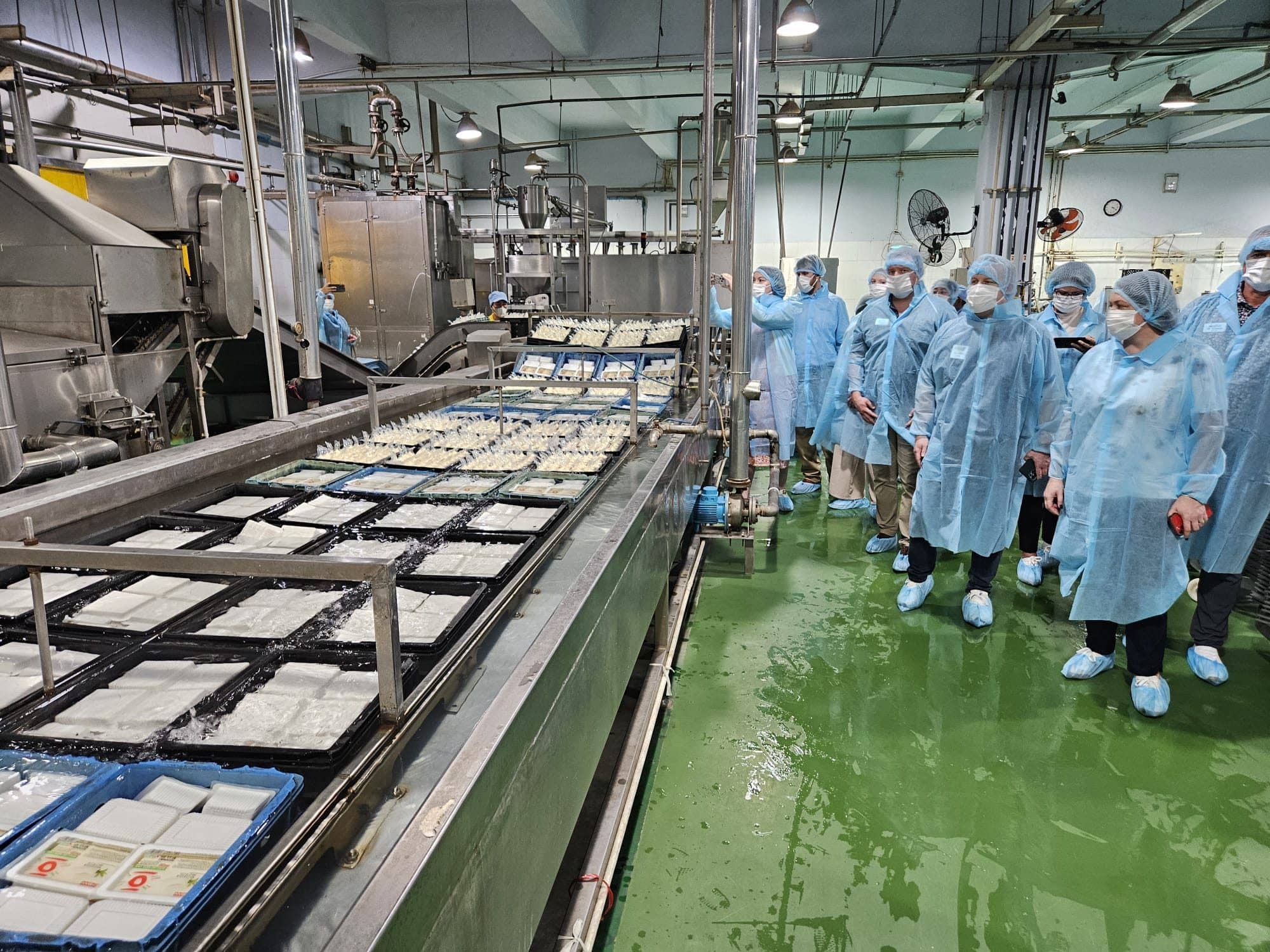
“You don’t realize how big soy foods are until you see it,” Montgomery said. “Tofu, soy yogurt, soy milk lining the shelves at convenience stores. It’s not niche. It’s everyday nutrition.”
Ted Brandt, an Enderlin farmer and NDSC director, sees clear long-term potential.
“With populations growing and diets changing, there’s real opportunity in Vietnam and across eastern Asia,” Brandt asserted. “There are opportunities in other parts of Asia and even the Middle East, too. It’s about being less reliant on one market and strengthening others.”
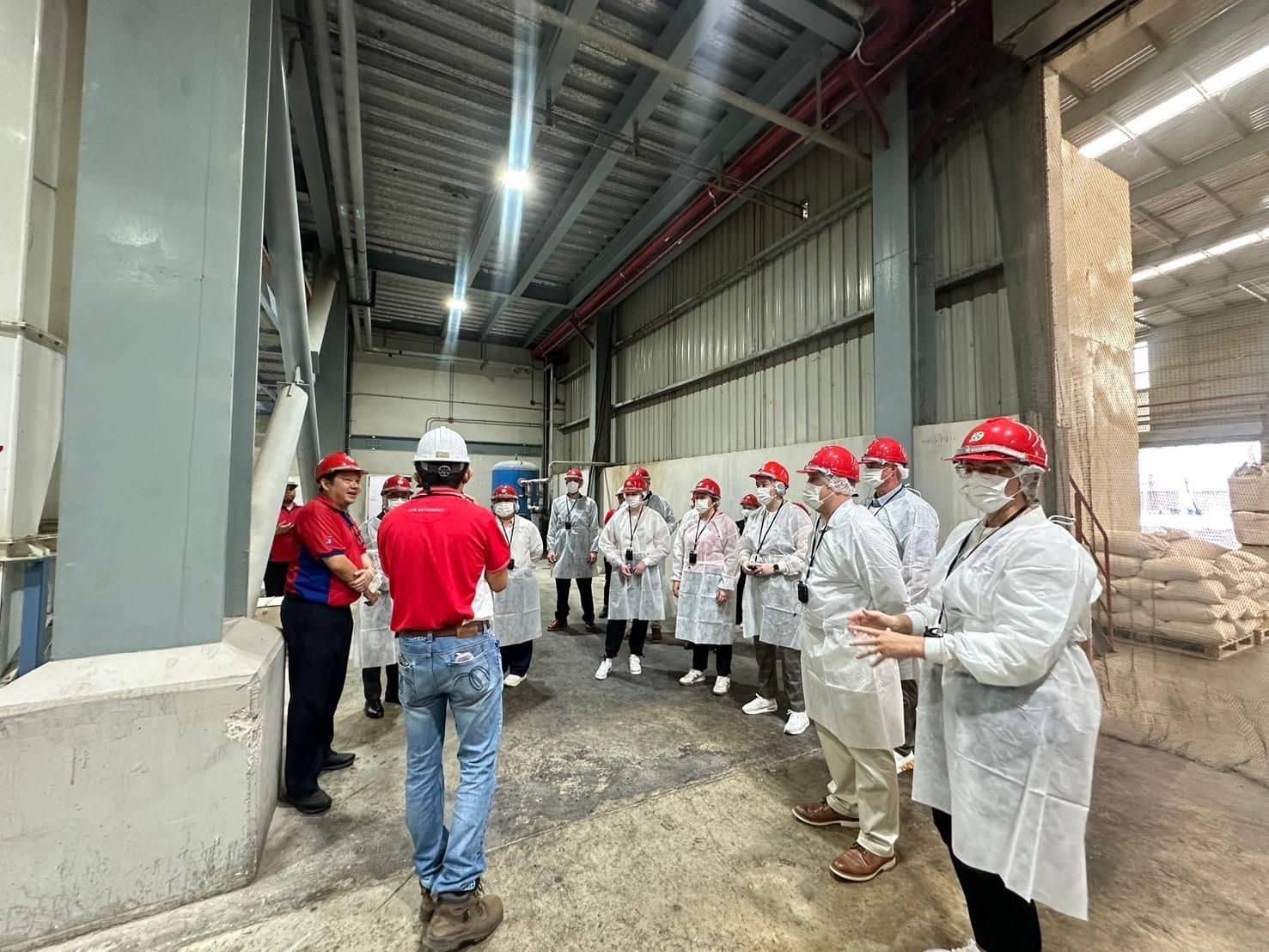
The delegation toured beverage facilities, visited feed mills, and met with crushers and agricultural industry representatives. The representatives walked through factories that produce tofu and soy drinks. The delegates observed feed being formulated for fish, chickens and livestock. Each stop reinforced the same message: Southeast Asia is competitive, but it is open to high-quality, consistent suppliers.
Quality that Shows
Throughout the mission, quality remained front and center.
At one feed mill in Thailand, Montgomery saw the difference in soybean meal side by side.
“We looked at two bunkers of soybean meal,” he explained. “One was off color and bridging. The other was dry, clean and flowed well. That was U.S. soybean meal. Seeing it side by side made the point clear.”
Flowability affects efficiency. Moisture affects storage. Color can indicate processing quality. Feed mill managers and nutritionists notice these details because those factors affect performance and cost.
The buyers emphasized that U.S. soybean meal stores well, moves smoothly through equipment and delivers predictable nutritional value in feed rations. That consistency begins long before the product reaches a ship.
“Probably their biggest question was about last year’s crop quality,” stated Mark Knutson, an NDSGA director from Fargo. “We told them what we always tell customers. We wait for the right moisture to harvest, and our cold climate helps us store beans in excellent condition. That shows up in their end product.”
Soy foods are not secondary in this region. They are staple items, making quality even more critical.
“When soy ends up in tofu or soy milk, consumers can taste and see the difference,” Montgomery said. “Processors want beans they can rely on.”
Sustainability Matters More than Ever
Beyond quality, sustainability is increasingly part of purchasing decisions. Governments are setting environmental benchmarks. Consumers, especially younger generations, are asking more questions about sourcing and environmental impact.
“Lots of governments now are putting in sustainability practices and quotas,” Hansen added. “The U.S. grows a very sustainable crop compared to some other regions. We track our carbon footprint. Our emissions are lower than in some competing areas. Buyers are paying attention to that.”
Sustainability conversations are no longer theoretical. They influence procurement strategies and long-term contracts. Being able to speak directly with farmers about conservation practices, crop rotation, precision agriculture and responsible land use adds credibility.
Having farmers in the room makes a difference. “When customers can ask questions directly and hear answers from the people who grow the crop, it builds confidence,” Hansen stated.
Relationships Close the Gap
While product performance and sustainability credentials are important, relationships often tip the scale.
One Thai buyer shared a candid story with the delegation.
“He told us he used to buy Canadian beans because they came to visit him,” Montgomery declared. “When U.S. representatives started showing up consistently, he shifted to U.S. soy. That face-to-face connection made the difference.”
In many parts of the world, purchasing decisions are relational. Trust develops over time, through repeated visits and honest conversations.
“They were so appreciative of being able to talk to farmers,” Cook explained. “They told us they prefer our beans. Yes, they can be more expensive. But when you have that personal relationship and connection, that carries weight.”
For Milo Braaten, the NDSC secretary and a farmer from Portland, the trade mission highlighted how those connections compound over time. One industry representative whom the group met had previously visited Braaten’s North Dakota farm as part of a trade delegation.
“That’s a building block,” Braaten said. “They’ve seen our farms and facilities. Now, we’re showing up on their side of the world. It shows we care. It shows we value the partnership.”
That reciprocity strengthens loyalty and keeps communication channels open, even when markets fluctuate.
Learning with Purpose
For many of the participating farmer-leaders, it was their first international trade mission. The experience broadened their understanding of how interconnected agriculture has become.
“Gaining global perspective is increasingly important in agriculture,” stated Billie Lentz, an NDSGA director and a farmer from Perth. “Seeing how food, culture and livelihoods connect across borders changes how you view your own role as a producer.”
Hansen echoed that sentiment. “You can read reports and look at data,” she said. “But until you walk through a tofu plant or watch fish feed being made, it doesn’t fully click. Seeing it firsthand gives farmers a deeper appreciation for where their soybeans go.”
That perspective often returns home with them, influencing conversations with neighbors, local elevators and industry partners.
A Strategic Investment in the Future
China remains a dominant force with global soybean demand. As Thompson pointed out, “China crushes the equivalent of a 110-car shuttle train of soybeans every 45 to 50 minutes. You can’t replace that overnight.”
Diversification is not about replacement. It is about resilience.
Trade missions like this one are funded by soybean checkoff dollars. Those funds are carefully invested to build demand, to expand market access, and to protect the value of the crop grown by North Dakota farmers.
“North Dakota farmers continue to compete in a global marketplace, and missions like this make clear how essential it is to keep expanding our reach,” said Stephanie Sinner, the NDSC executive director. “When our farmer leaders meet customers face to face, they are not just promoting North Dakota soy. They are building trust that protects the future of our industry. Diversifying markets across southeast Asia is not simply a smart strategy. It is a necessary investment in resilience for every soybean grower back home.”
The delegation returned from southeast Asia energized. The delegates saw firsthand the scale of opportunity, the importance of consistency and the value of showing up.
From beverage production lines in Thailand to aquaculture platforms in Vietnam’s Mekong Delta, North Dakota soybeans are helping feed a growing world. The demand in those markets does not build itself. It requires presence, patience and persistence.
Standing on that floating fish farm, watching feed hit the water, Montgomery saw the result of those efforts. “It really makes you think differently about what we do back home,” he exclaimed. “We’re not just growing soybeans for the elevator down the road. We’re growing for families halfway around the world.”
That fact is exactly why North Dakota’s soybean leaders are determined to keep building a more resilient future for North Dakota’s soybean farmers.
ABOUT THE NORTH DAKOTA SOYBEAN COUNCIL:
North Dakota soybean farmers across the state are represented on the North Dakota Soybean Council Board, which oversees a promotion, research and marketing program funded by soybean checkoff dollars. The Council’s mission is to innovate to expand partnerships, markets, and opportunities for the success of North Dakota soybean growers.