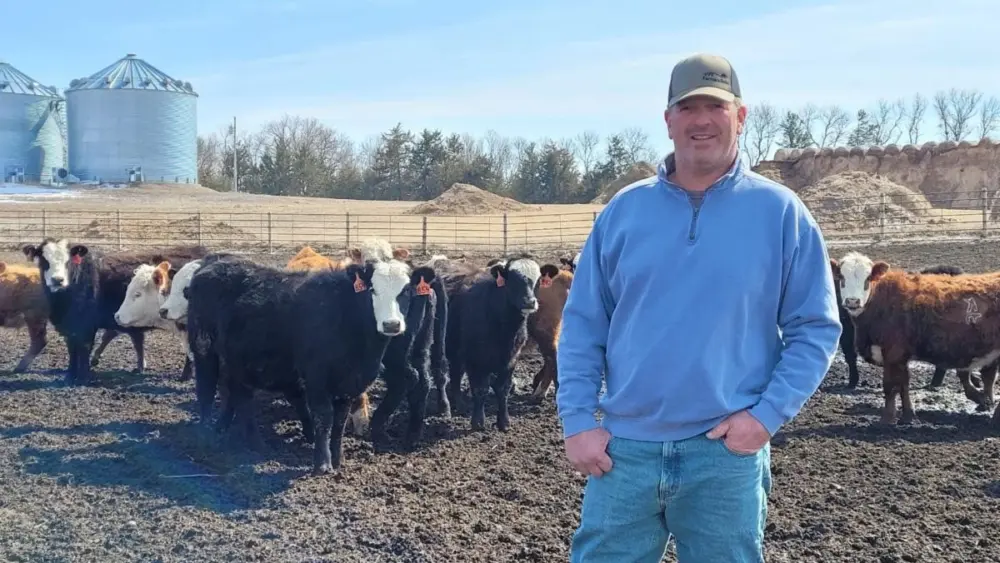
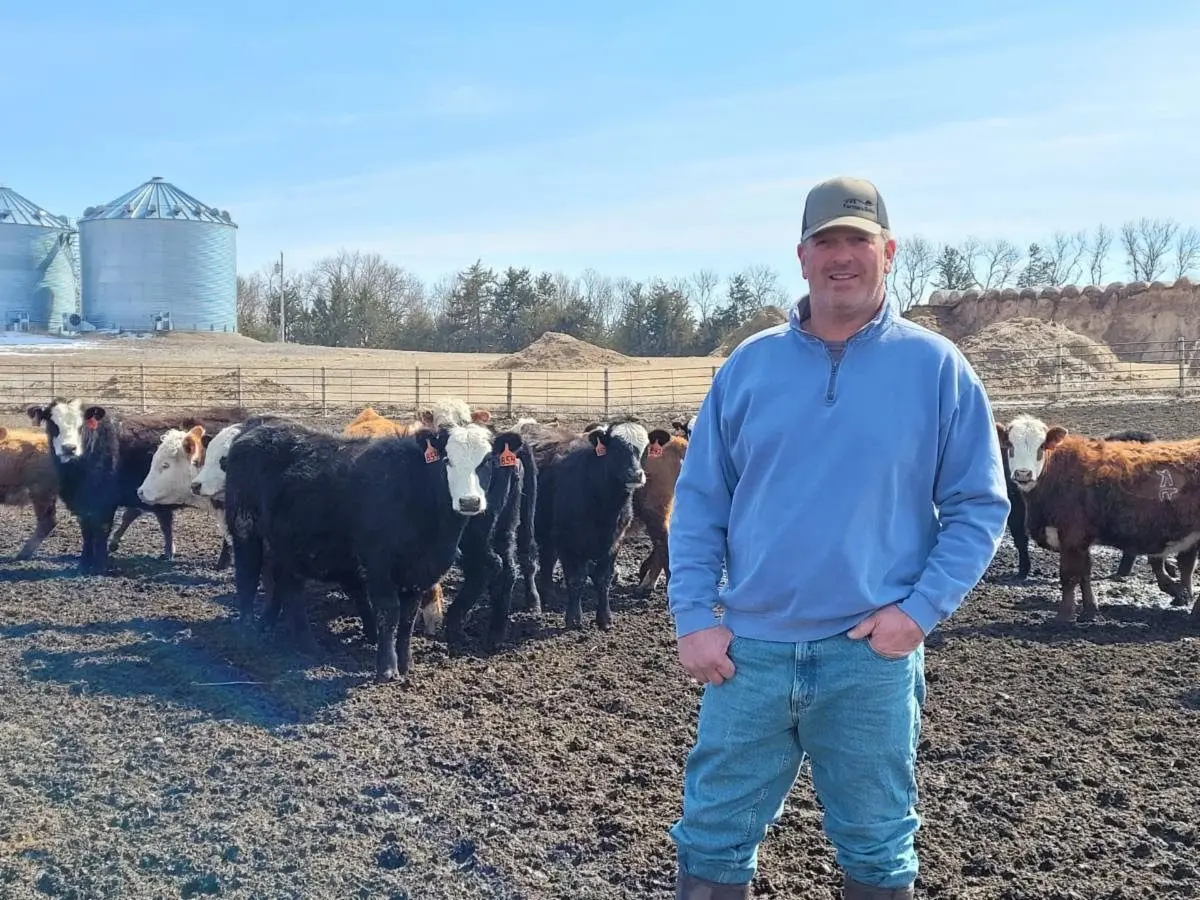
Scott Kolousek is a Wessington Springs cattle producer and Farmers Union board member. He is among the members of the state's largest grassroots agriculture organization who have urged Congressional leaders to re-instate mandatory country of origin labeling (MCOOL).
Raising cattle is tough work. And the cattle ranchers who have the grit to take on the task of feeding and protecting the U.S. beef supply through blizzards, drought and 3 a.m. calving emergencies will tell you although it can be grueling at times, the work is rewarding.
“I like the journey of ranching,” Jason Latham said. “And every calving season we get to start the journey over and there is great optimism, like anything is possible. We bring these baby calves into the world, and we get to care for them and watch them grow.”
A fifth-generation Harding County rancher, Latham grew up caring for cattle on the same land his great-great uncle, Bejamin “Doc” Latham homesteaded. Today, he and his wife, Kaeloni have three young sons who get to do the same.
Although Latham loves the work and lifestyle cattle ranching provides, when he reflects on his bank account, his tone changes.
“I’m 38, and this is only the second time in my lifetime when I’ve felt like we were in a good spot – where cattle prices were at a place where we were making money over expenses and we could reinvest in the ranch, like upgrade a tractor we’ve had for 50 years, or buy more heifers instead of selling them to pay off our operating note,” Latham explained.
Today, Latham fears the “good spot” is gone. It’s five days after President Trump’s October 22 comments focused on removing tariffs on Argentine beef. Allegedly, the idea is increasing foreign beef imports, will lower the price of beef in the grocery store.
Grocery store prices have yet to respond, according to R.F. Buche, owner of Buche Foods grocery stores. But the cattle markets didn’t waste any time, explained commodities broker DuWayne Bosse. On October 21 feeder cattle futures were selling at $373.47 per hundred weight. October 27 at 12:20 p.m. when Bosse shared his thoughts, they were at $338.45.
“We are still dropping. We are down our limit today and I expect we will be sharply lower tomorrow. We have not found a bottom,” Bosse said. “Sadly, the cash market is down even harder from what I hear, it is tumbling at sale barns right now.”
Reliance rancher, David Reis felt the sting when he sold yearlings at the sale barn. The 18-month-old cattle sold for $120 less per head than a week earlier.
“The only thing that changed were the comments by the president,” explained the fourth-generation Reliance rancher. “Our president should not use another country to manipulate U.S. markets. …The markets are supposed to set themselves. It’s supposed to be supply and demand.”
It Is Time for Mandatory Country of Origin Labeling (MCOOL)
President Trump’s America-first policies are among the reasons Latham and his rancher friends and neighbors voted for him.
“Rural America came out to support him incredibly hard and he just slapped us in the face,” Latham said. “It is frustrating because he said, “I’m going to take care of America first.” And he is doing the exact opposite. And then he said we don’t understand the markets. We do understand the markets because they determine our livelihood.”
As he waits for the markets to rally before selling his weaned calves, Latham said he and other U.S. cattle producers need mandatory country of origin labeling (MCOOL) if they are going to be able to compete in markets inundated with foreign beef.
“I’d be OK with the U.S. allowing more Argentine beef in if there was mandatory labeling because the American consumer has proven they will buy locally when they are given a choice,” Latham said.
Scott Kolousek, a Wessington Springs cattle producer and Farmers Union board member had similar thoughts. “Hopefully we can use this unified frustration and anger to get the momentum we need for MCOOL,” said Kolousek, who traveled to D.C. to talk to Congressional leaders about re-instating MCOOL following the Black Swan events of 2019, 2020 and 2021.
“Grocery store prices on beef were up then too. But cattle producers were losing money,” Kolousek said. “Cattle producers have zero control over what grocery store prices are. There is no guarantee that introducing foreign beef into the market will lower prices in the grocery stores. What we do know is it is hurting U.S. cattle producers.”
Constructive dialogue around MCOOL is what Doug Sombke, President of South Dakota Farmers Union is working for. Re-instating MCOOL has been a focus of the grassroots policy of the state’s largest agriculture organization since the labeling requirement was removed on meat products in 2015.
“Consumers deserve to know where their food comes from. They deserve to have the choice. MCOOL gives consumers a choice to buy U.S. or foreign beef. MCOOL gives U.S. cattle producers a fair market,” Sombke said. “Without MCOOL, the only winner is Argentina. If you want to increase the supply of beef in the U.S., ranchers have to be able to afford to increase their herd size. They can’t grow their herd if they can’t afford to.”
To encourage Congress to re-instate MCOOL, call 202-224-3121. To learn more about how South Dakota Farmers Union supports family farmers and ranchers, visit www.sdfu.org.