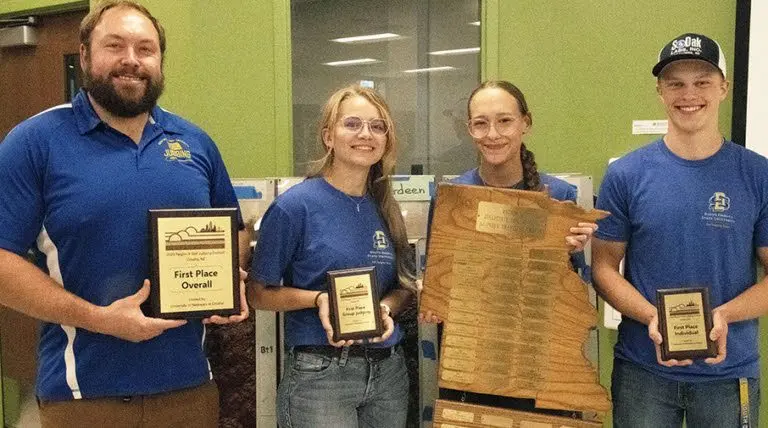
The SDSU Soil Judging Team brought home first-place honors from the National Collegiate Soil Judging Region 5 competition held recently in Omaha, Nebraska. Pictured from left are assistant professor of soils and pedology in the Department of Agronomy, Horticulture and Plant Science Kristopher Osterloh, with team members Harlee Nielson, Abigayle Eitreim and senior team leader Luke Desmith, who also won first place in the individual judging category. The team will travel this spring to North Carolina State University for national competition. (SDSU)
BROOKINGS, S.D. — The South Dakota State University Soil Judging Team made an impressive showing at the recent National Collegiate Soil Judging Region 5 competition, garnering first-place awards in both the team and individual categories. Helping to bring home the team’s overall first-place score was individual top winner Luke Desmith, a senior agronomy major from Walnut Grove, Minnesota.
The regional contest included nine collegiate teams from South Dakota, North Dakota, Nebraska, Kansas, Missouri, Iowa and Minnesota. The overall first-place win qualifies the SDSU students to participate in the national competition this spring at North Carolina State University, sponsored by the Soil Science Society of America.
“I am extremely proud of the showing of our SDSU Soil Judging Team. Dr. Kris Osterloh did an amazing job preparing the students for the contest,” Karen Sanguinet, Klingbeil Endowed Department Head and professor in the Department of Agronomy, Horticulture and Plant Science, said. “I look forward to hosting the trophy for the next year and seeing how our Soil Judging Team fares at nationals.”
Osterloh, an assistant professor of soils and pedology in the Department of Agronomy, Horticulture and Plant Science, appreciates the meaningful experience competition provides his students. “One of the things that makes soil judging great is the experiential learning. I’m a big proponent of ‘learn by doing,’ and getting the time to dedicate full days to being outside and experiencing a soil in place, with the landscape and land management all around you, are truly unforgettable.
“It also gives students the direct connection of some otherwise abstract concepts that we use in the classroom,” Osterloh continued, “such as how the surrounding environmental factors (geology, climate, topography, organisms and time) actually come together to form a soil.”
Regional competitors arrived a few days prior to the competition, spending time with sample soils from the Omaha region, becoming familiar with the characteristics of the soil and the region prior to contest day. On the day of the event, students evaluate the official contest soil and rate it in five categories: landscape, soil morphology, hydraulic properties, taxonomy (classification) and site interpretation. Their answers are graded against a rubric, and the top numerical scores win. Results are double verified, with at least two judges grading every evaluation sheet. A similar protocol will be followed at the national competition in North Carolina this spring.
Team members are enrolled in Osterloh’s soil judging class and come from many different majors, including agronomy, agricultural education, biochemistry, natural resource management and engineering. “It’s a great way for students who are not focused on soil but are soil adjacent to get an in-depth crash course on all things soil,” Osterloh said.
Desmith is appreciative of this experiential learning. “Being part of the soil judging team has been an amazing opportunity to apply what I have learned in the classroom to the field,” Desmith said. “It has deepened my understanding of soil and land management while providing valuable experience that I can draw on in my future career in agriculture.”
Osterloh is in his seventh year at SDSU. He brought to his faculty position experience in soil judging and coaching while earning his master’s degree from Northern Illinois University and his doctorate from Oregon State University. He is a firm believer that students who participate in competitive soil judging gain real-world experience that help prepare them for a variety of careers.
“Soil judging is one of the few classes where students get to fully bridge the lecture hall to the professional world,” Osterloh said. “We don’t just get to see and study cool soils in other places; the students get to see how the landowners manage their land and what impacts that has on the soil.”
Interaction with soil scientists who set up and judge the contests is beneficial. “We often get the opportunity to meet the landowners and the Natural Resources Conservation Service soil scientists who help set up the contest,” Osterloh said. “Students not only get to see what a soil scientist does, but they are actually doing a simplified version of what a professional soil scientist does for a living. It’s a great experience for any level of professional development.”
Osterloh said that employers and graduate schools notice collegiate judging on students’ resumes. “The Natural Resources Conservation Service and other government agencies love to see soil judging experience because they know that you have some actual experience and skills doing fieldwork, and grad school advisors like soil judges because they are dedicated and passionate about really understanding how soils form and function.”