Photo credit: Elena Berd - stock.adobe.com
(BATON ROUGE, LA) — The fertilizer and fuel price spikes squeezing U.S. agriculture are not a regional story. They are reshaping farm balance sheets from the Mid-South to the Midwest, and an LSU agricultural economist says the relief producers are hoping for is unlikely to come fast.
“This isn’t a Louisiana thing or a Mid-South thing. This issue is very real and is resonating across farm country right now,” Dr. Michael Deliberto of the LSU AgCenter said in a recent interview on Market Talk. The numbers he shared come from Louisiana enterprise budgets, but the cost pressures he detailed mirror what producers are reporting nationwide.
Coming into 2026, Deliberto said most farmers and lenders already expected a difficult year. Louisiana growers were buoyed by record corn and cotton yields in 2025, and the “one big beautiful bill” handed producers an improved farm safety net. Still, the agricultural lending environment was tight, and geopolitical disruption has scrambled the math even further. Even after a meaningful run-up in futures, Deliberto said, “we still got a long way to go to get some of these costs absorbed.”
The Fertilizer Reality
Louisiana corn producers typically apply 200 to 250 pounds of nitrogen per acre, depending on soil. Between early January and the end of April, Deliberto said, the jump in nitrogen prices alone added between $66 and $83 per acre to the corn budget — figures that apply almost identically to any Mid-South or Midwest grower running comparable agronomic recommendations.
“I don’t think anybody’s got to be an economist to realize when you start talking about $60, $80 more an acre just on one area of your farm budget, well, you know, (then) what are market prices doing,” he said. “Yes, futures prices have gone up. I think that’s been great for the market right now, but unfortunately, in terms of where our producers need to be with cost of production, our land rents are pretty high here in Louisiana, pretty high in the Mid-South. You know, this is going to allow us at $4.75 corn to maybe break even, show a little bit of a profit covering our variable cost, but that doesn’t come close to covering rent, fixed cost. You know, we’re pushing $6 a bushel when we want to be all in from a production standpoint, because since January, we’ve just seen one increase after another with N, P, and K, as well as what diesel fuel is doing.”
Louisiana also had to replant roughly 200,000 acres of corn after a March freeze, layering an unexpected expense on top of an already inflated budget.
The Diesel Shock
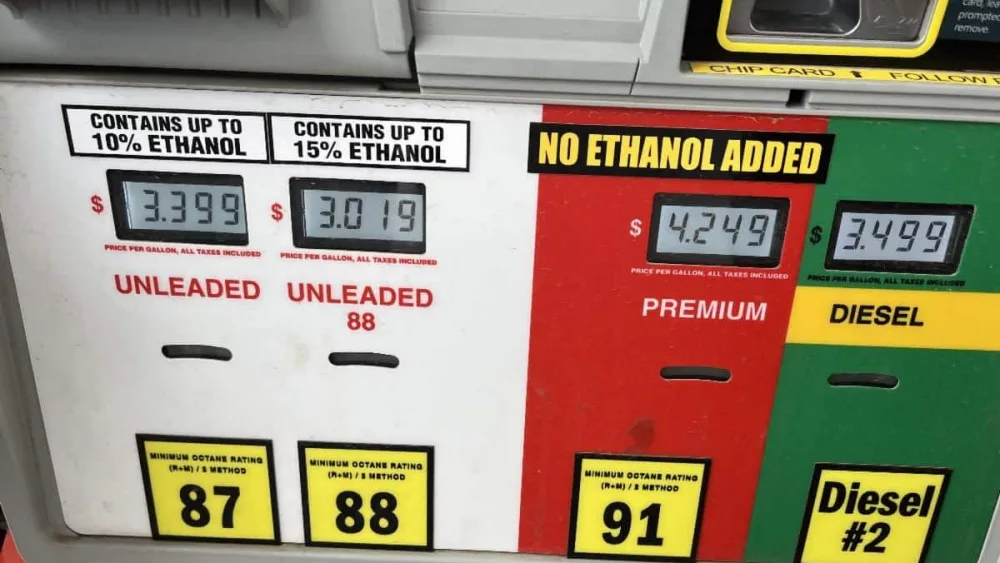
The fuel side may be the more dramatic story. Deliberto said diesel jumped from $2.85 a gallon in early January to $4.87 a gallon at the close of April, driven in part by Middle East conflict and disruption around the Strait of Hormuz. For corn under poly pipe irrigation, common in Louisiana, that translates to a relatively modest 9 to 11 gallons of diesel per acre. For rice grown under continuous flood — the dominant production system in Louisiana — the math is brutal: about 35 gallons of diesel per acre across six applications and 24 acre-inches of water.
“When diesel goes from $2.85 a gallon, where it was in January, to $4.87 a gallon, as it was to close out April, that really is devastating for the rice industry,” he said.
Higher Futures, Lower Returns
The cruelest twist in 2026’s economics is that the markets have actually rallied. From January 2 to May 7, the September corn contract that Louisiana growers watch for crop insurance picked up roughly 31 cents. Yet because fertilizer and fuel rose faster, Deliberto said, “our net returns an acre have actually gone down” on irrigated corn.
He pegs Louisiana’s variable cost of production at about $4.46 per bushel on 190-bushel corn. Add an average cash rent of $140 per acre across the seven-parish Louisiana Delta, and the figure clears $5. Once machinery ownership, irrigation pumps, and other fixed expenses are layered in, all-in cost of production lands near $6.05 a bushel. Recent estimates out of the Mississippi Delta have the regional figure right around $5.90 — a strikingly similar conclusion arrived at from a different state’s data.
That gap is why $4.75 corn lets some Louisiana growers cover variable cost but, as Deliberto put it, “doesn’t come close to covering rent” or fixed cost.
Where the Market is Helping — and Where it Isn’t
The picture is not uniformly bleak. Louisiana soybean acres are running lighter than the typical 1.1 million-acre baseline — closer to 860,000 — as growers leaned away from higher-cost corn. With the rally on the November contract, Deliberto said the soybean budget actually pencils a profit at 60-bushel yields even after rent. Cotton has flipped from “barely covering your variable cost of production” at 65- to 68-cent prices into showing returns above rent at the current 83-cent new-crop level, though he noted the industry still needs “dollar cotton” to fully absorb the cost of $1 million-plus pickers and round balers. Rice, which had some January quotes “with a nine in front of them,” has rallied enough to ease — but not erase — deep concerns in a long-grain-export-dependent state.
The Long Tail
Producers hoping for a quick reset on inputs should temper expectations. “I don’t think this is a situation that’s going to alleviate itself in the next 10 days,” Deliberto said. Even if Middle East tensions cooled tomorrow, fertilizer takes roughly 60 days to move from the region to U.S. ports, and Midwestern producers face additional river-system logistics before product reaches the retail level.
His advice for navigating both 2026, and what looks like a volatile 2027 setup, is unglamorous but specific: know your cost of production cold, treat ARC and PLC payments as part of a broader marketing plan rather than as a windfall, and book pieces of production when the market hands you a chance to cover variable costs.
“If the market’s sending you a signal where you could book some break-even and cover some of those costs,” Deliberto said, “really… hold that production… to fight another day.”
***Watch the full conversation with Dr. Michael Deliberto from LSU in the Market Talk video below: