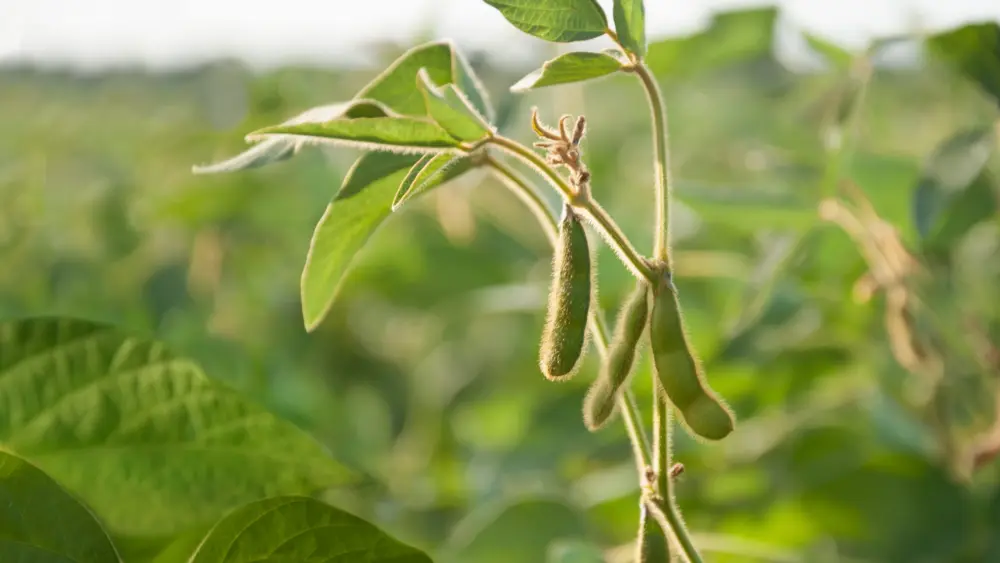
WASHINGTON (Sept. 11, 2025) — Hybrid seeds, produced by cross-pollinating crops to improve the offspring’s characteristics, have higher yields and can increase farmer profits. However, creating hybrids is labor-intensive and difficult to perform on many popular crops, including soybeans. To increase yield and profit for soybean farmers, the Foundation for Food & Agriculture Research (FFAR) and its Crops of the Future (COTF) Collaborative partners Bayer, KWS and United Soybean Board are providing a $4,050,000 grant to the ApoSoy project to develop a lower-cost process for producing hybrid soybeans.
“Creating consistently high yielding soybean at lower prices will be a boon to farmers in the U.S. and around the world growing a commonly consumed, nutritional and versatile crop,” said Dr. Kathy Munkvold, FFAR scientific program director.
Although hybrid seeds outperform their parents in yield, this advantage does not transfer to the hybrids’ offspring. Breeders must continually cross-pollinate to develop the next generation of hybrids. Because soybeans reproduce through self-pollination, the structure of the soybean flower makes cross-pollination difficult and expensive. The ApoSoy project seeks to develop a cost-effective hybrid soybean system through a process called apomixis, which creates seeds that are genetic clones of the parent.
“To address farmers’ needs and to broaden their toolbox, we join forces with partners of all sizes to help actively seek new creative ideas in the ag space,” said JD Rossouw, breeding lead in Bayer’s Crop Science division. “This way, it fuels fundamental shifts in thinking while helping to shape the agriculture of tomorrow.”
The ApoSoy research team involves an international collaboration from Max Planck Institute of Molecular Plant Physiology, University of Regensburg, Radboud University, University of Georgia College of Agricultural and Environmental Sciences, Wageningen University & Research, Whitehead Institute for Biomedical Research and University of Zurich. The researchers are developing various apomixis technologies in model plants and transferring these techniques to soybeans to create a hybrid seed with offspring that produces high yields without the need for cross-pollination.
“ApoSoy brings together experts in plant reproduction who are researching all developmental facets involved in apomixis that, when combined, may lead to pathways to achieve efficient asexual reproduction in legumes,” said Dr. Peggy Ozias-Akins, distinguished research professor at University of Georgia and project co-principal investigator.